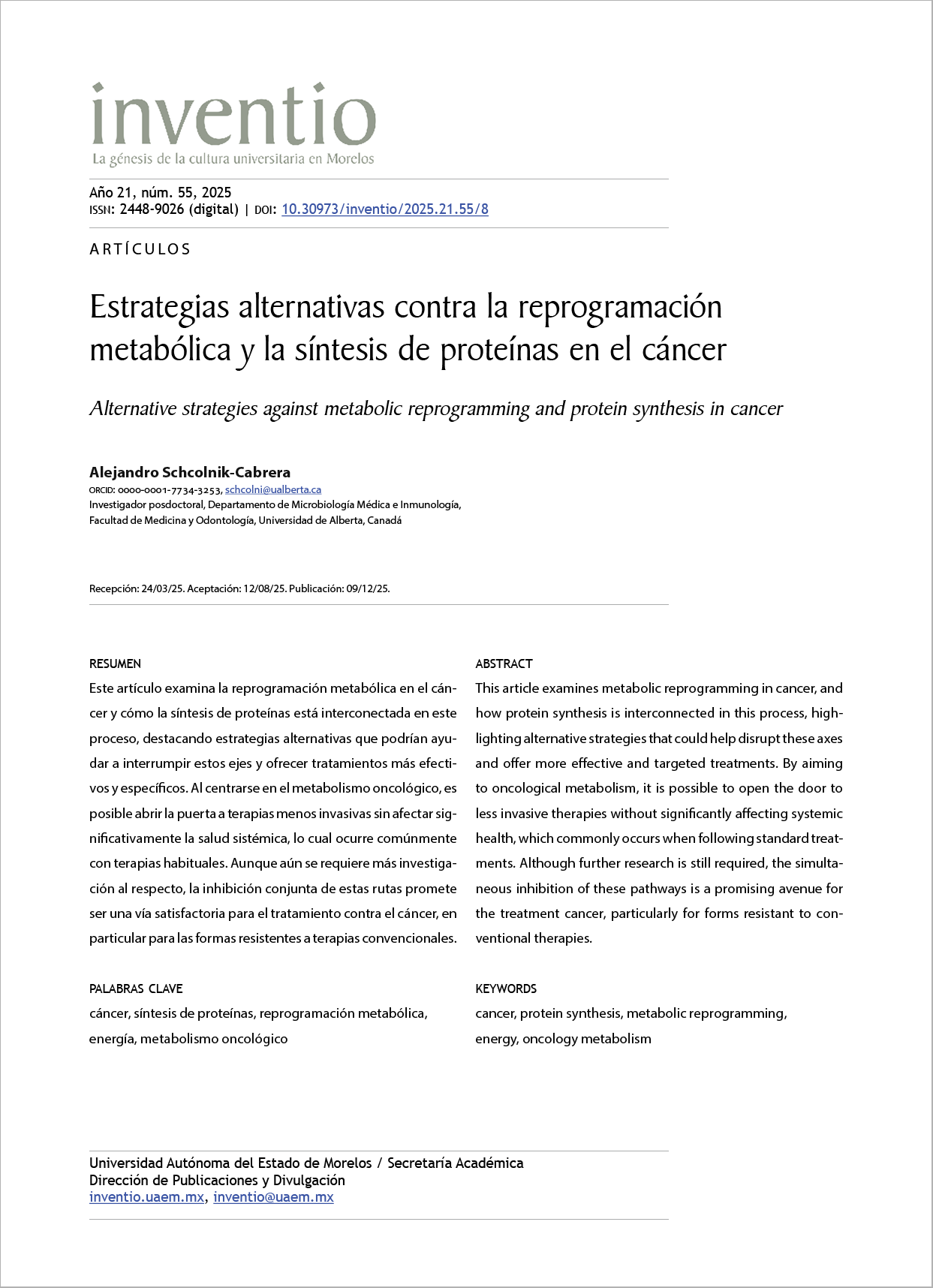
Estrategias alternativas contra la reprogramación metabólica y la síntesis de proteínas en el cáncer
DOI:
https://doi.org/10.30973/inventio/2025.21.55/8%20Palabras clave:
Cáncer, Reprogramación metabólica, Energía, Metabolismo oncológico, síntesis de proteínasResumen
Este artículo examina la reprogramación metabólica en el cáncer y cómo la síntesis de proteínas está interconectada en este proceso, destacando estrategias alternativas que podrían ayudar a interrumpir estos ejes y ofrecer tratamientos más efectivos y específicos. Al centrarse en el metabolismo oncológico, es posible abrir la puerta a terapias menos invasivas sin afectar significativamente la salud sistémica, lo cual ocurre comúnmente con terapias habituales. Aunque aún se requiere más investigación al respecto, la inhibición conjunta de estas rutas promete ser una vía satisfactoria para el tratamiento contra el cáncer, en particular para las formas resistentes a terapias convencionales.
Referencias
Abel, K. y Jurnak, F. (1996). A complex profile of protein elongation: translating chemical energy into molecular movement. Structure, 4(3), 229-238. https://doi.org/10.1016/s0969-2126(96)00027-5
Akram, M. (2013). Mini-review on glycolysis and cancer. Journal of Cancer Education, 28(3), 454-457. https://doi.org/10.1007/s13187-013-0486-9
Al-Kuraishy, H. M., Sulaiman, G. M., Mohsin, M. H., Mohammed, H. A., Dawood, R. A., Albuhadily, A. K., Al-Gareeb, A. I., Albukhaty, S. y Abomughaid, M. M. (2025). Targeting of AMPK/MTOR signaling in the management of atherosclerosis: outmost leveraging. International Journal Biological Macromolecules, 309, parte 2, 142933. https://doi.org/10.1016/j.ijbiomac.2025.142933
Basso, P. J., Schcolnik-Cabrera, A., Zhu, M., Strachan, E., Clemente-Casares, X. y Tsai, S. (2025). Weight loss-associated remodeling of adipose tissue immunometabolism. Obesity Reviews, 26(12), e13975. https://doi.org/10.1111/obr.13975
Bian, X., Liu, R., Meng, Y., Xing, D., Xu, D. y Lu, Z. (2021). Lipid metabolism and cancer. Journal of Experimental Medicine, 218(1), e20201606. https://doi.org/10.1084/jem.20201606
Borst, P. (2012). Cancer drug pan-resistance: pumps, cancer stem cells, quiescence, epithelial to mesenchymal transition, blocked cell death pathways, persisters or what? Open Biology, 2(5), 120066. https://doi.org/10.1098/rsob.120066
Butler, M., Van der Meer, L. T. y Van Leeuwen, F. N. (2021). Amino acid depletion therapies: starving cancer cells to death. Trends in Endocrinology & Metabolism, 32(6), 367-381. https://doi.org/10.1016/j.tem.2021.03.003
Cencic, R., Carrier, M., Galicia-Vázquez, G., Bordeleau, M.-E., Sukarieh, R., Bourdeau, A., Brem, B., Teodoro, J. G., Greger, H., Tremblay, M. L. Porco Jr., J. A. y Pelletier, J. (2009). Antitumor activity and mechanism of action of the cyclopenta[b]benzofuran, silvestrol. PLoS One, 4(4), e5223. https://doi.org/10.1371/journal.pone.0005223
Chan, K., Robert, F., Oertlin, C., Kapeller-Libermann, D., Avizonis, D., Gutiérrez, J., Handly-Santana, A., Doubrovin, M., Park, J., Schoepfer, C., Da Silva, B., Yao, M., Gorton, F., Shi, J., Thomas, C. J., Brown, L. E., Porco Jr., J. A., Pollak, M., Larsson, O., Pelletier, J. y Chio, I. C. (2019). eIF4A supports an oncogenic translation program in pancreatic ductal adenocarcinoma. Nature Communications, 10(1), 5151. https://doi.org/10.1038/s41467-019-13086-5
Chandel, N. S. (2021). Lipid metabolism. Cold Spring Harbor Perspectives Biology, 13(9). https://doi.org/10.1101/cshperspect.a040576
Chen, G., Bao, B., Cheng, Y., Tian, M., Song, J., Zheng, L. y Tong, Q. (2023). Acetyl-CoA metabolism as a therapeutic target for cancer. Biomedicine & Pharmacotheraphy, 168, 115741. https://doi.org/10.1016/j.biopha.2023.115741
Chen, Q., Kirk, K., Shurubor, Y. I., Zhao, D., Arreguin, A. J., Shahi, I., Valsecchi, F., Primiano, G., Calder, E. L., Carelli, V., Denton, T. T., Beal, M. F., Gross, S. S., Manfredi, G. y D’Aurelio, M. (2018). Rewiring of glutamine metabolism is a bioenergetic adaptation of human cells with mitochondrial DNA mutations. Cell Metabolism. A Cell Press Journal, 27(5), 1007-1025. https://doi.org/10.1016/j.cmet.2018.03.002
Cluntun, A. A., Lukey, M. J., Cerione, R. A. y Locasale, J. W. (2017). Glutamine metabolism in cancer: understanding the heterogeneity. Trends Cancer, 3(3), 169-180. https://doi.org/10.1016/j.trecan.2017.01.005
Cohen, A. L., Holmen, S. L. y Colman, H. (2013). IDH1 and IDH2 mutations in gliomas. Current Neurology and Neuroscience Reports, 13(5), 345. https://doi.org/10.1007/s11910-013-0345-4
Cordova, R. A., Misra, J., Amin, P. H., Klunk, A. J., Damayanti, N. P., Carlson, K. R., Elmendorf, A. J., Kim, H.-G., Mirek, E. T., Elzey, B. D., Miller, M. J., Dong, X. C., Cheng, L., Anthony, T. G., Pili, R., Wek, R. C. y Staschke, K. A. (2022). GCN2 eIF2 kinase promotes prostate cancer by maintaining amino acid homeostasis. eLife, 11, e81083. https://doi.org/10.7554/elife.81083
Ebright, R. Y., Lee, S., Wittner, B. S., Niederhoffer, K. L., Nicholson, B. T., Bardia, A., Truesdell, S., Wiley, D. F., Wesley, B., Li, S., Mai, A., Aceto, N., Vincent-Jordan, N., Szabolcs, A., Chirn, B., Kreuzer, J., Comaills, V., Kalinich, M., Haas, W., … y Micalizzi, D. (2020). Deregulation of ribosomal protein expression and translation promotes breast cancer metastasis. Science 2020, 367(6485), 1468-1473. https://doi.org/10.1126/science.aay0939
Faubert, B., Solmonson, A. y DeBerardinis, R. J. (2020). Metabolic reprogramming and cancer progression. Science, 368(6487), eaaw5473. https://doi.org/10.1126/science.aaw5473
Flavin, R., Peluso, S., Nguyen, P. L. y Loda, M. (2010). Fatty acid synthase as a potential therapeutic target in cancer. Future Oncology, 6(4), 551-562. https://doi.org/10.2217/fon.10.11
Fooks, K., Galicia-Vázquez, G., Gife, V., Schcolnik-Cabrera, A., Nouhi, Z., Poon, W. W. L., Luo, V., Rys, R. N., Aloyz, R., Orthwein, A., Johnson, N. A., Hulea, L. y Mercier, F. E. (2022). EIF4A inhibition targets bioenergetic homeostasis in AML MOLM-14 cells in vitro and in vivo and synergizes with cytarabine and venetoclax. Journal of Experimental & Clinical Cancer Research, 41(1), 340. https://doi.org/10.1186/s13046-022-02542-8
Gatenby, R. A. y Gillies, R. J. (2004). Why do cancers have high aerobic glycolysis? Nature Reviews Cancer, 4(11), 891-899. https://doi.org/10.1038/nrc1478
Gife, V., Fooks, K., Berthelemy, J., Schcolnik-Cabrera, A., Galicia-Vázquez, G., Nouhi, Z., Aloyz, R., Rys, R. N., Johnson, N. A., Mercier, F. E. y Hulea, L. (2023). mRNA translation inhibition targets bioenergetic homeostasis in AML cells in vitro and in vivo and synergizes with cytarabine and venetoclax. Blood, 142, suplem. 1, 5742. https://doi.org/10.1182/blood-2023-186142
Gonsalves, W. I., Jang, J. S., Jessen, E., Hitosugi, T., Evans, L. A., Jevremovic, D., Pettersson, X. M., Bush, A. G., Gransee, J., Anderson, E. I., Kumar, S. K. y Nair, K. S. (2020). In vivo assessment of glutamine anaplerosis into the TCA cycle in human pre-malignant and malignant clonal plasma cells. Cancer & Metabolism, 8(1), 29. https://doi.org/10.1186/s40170-020-00235-4
Hajdu, S. I. (2011). A note from history: landmarks in history of cancer, part 1. Cancer, 117(5), 1097-1102. https://doi.org/10.1002/cncr.25553
Hanahan, D. y Weinberg, R. A. (2000). The hallmarks of cancer. Cell, 100(1), 57-70. https://doi.org/10.1016/s0092-8674(00)81683-9
Hanahan, D. y Weinberg, R. A. (2011). Hallmarks of cancer: the next generation. Cell, 144(5), 646-674. https://doi.org/10.1016/j.cell.2011.02.013
Hao, P., Yu, J., Ward, R., Liu, Y., Hao, Q., An, S. y Xu, T. (2020). Eukaryotic translation initiation factors as promising targets in cancer therapy. Cell Communication and Signaling, 18(1), 175. https://doi.org/10.1186/s12964-020-00607-9
Hardwick, J. M. y Soane, L. (2013). Multiple functions of BCL-2 family proteins. Cold Spring Harbor Perspectives in Biology, 5(2), a008722. https://doi.org/10.1101/cshperspect.a008722
Hawly, J., Murcar, M. G., Schcolnik-Cabrera, A. e Issa, M. E. (2024). Glioblastoma stem cell metabolism and immunity. Cancer and Metastasis Reviews, 43(3), 1015-1035. https://doi.org/10.1007/s10555-024-10183-w
Ho, B., Baryshnikova, A. y Brown, G. W. (2018). Unification of protein abundance datasets yields a quantitative saccharomyces cerevisiae proteome. Cell Systems, 6(2), 192-205. https://doi.org/10.1016/j.cels.2017.12.004
Hulea, L., Gravel, S.-P., Morita, M., Cargnello, M., Uchenunu, O., Im, Y. K., Lehuédé, C., Ma, E. H., Leibovitch, M., McLaughlan, S., Blouin, M.-J., Parisotto, M., Papavasiliou, V., Lavoie, C., Larsson, O., Ohh, M., Ferreira, T., Greenwood, C., Bridon, G., … y Topisirovic, I. (2018). Translational and HIF-1alpha-dependent metabolic reprogramming underpin metabolic plasticity and responses to kinase inhibitors and biguanides. Cell Metabolism, 28(6), 817-832. https://doi.org/10.1016/j.cmet.2018.09.001
Jewett, M. C., Miller, M. L., Chen, Y. y Swartz, J. R. (2008). Continued protein synthesis at low [ATP] and [GTP] enables cell adaptation during energy limitation. Journal of Bacteriology, 191(3), 1083-1091. https://doi.org/10.1128/JB.00852-08
Jia, X., He, X., Huang, C., Li, J., Dong, Z. y Liu, K. (2024). Protein translation: biological processes and therapeutic strategies for human diseases. Signal Transduction and Targeted Therapy, 9, 44. https://doi.org/10.1038/s41392-024-01749-9
Jiménez-Valerio, G. y Casanovas, O. (2017). Angiogenesis and metabolism: entwined for therapy resistance. Trends in Cancer, 3(1), 10-18. https://doi.org/10.1016/j.trecan.2016.11.007
Jin, J., Byun, J.-K., Choi, Y.-K. y Park, K.-G. (2023). Targeting glutamine metabolism as a therapeutic strategy for cancer. Experimental & Molecular Medicine, 55(4), 706-715. https://doi.org/10.1038/s12276-023-00971-9
Kang, J.-S. (2020). Dietary restriction of amino acids for cancer therapy. Nutrition & Metabolism, 17, 20. https://doi.org/10.1186/s12986-020-00439-x
Kim, H.-J., Maiti, P. y Barrientos, A. (2017). Mitochondrial ribosomes in cancer. Seminars in Cancer Biology, 47, 67-81. https://doi.org/10.1016/j.semcancer.2017.04.004
Kridel, S. J., Axelrod, F., Rozenkrantz, N. y Smith, J. W. (2004). Orlistat is a novel inhibitor of fatty acid synthase with antitumor activity. Cancer Research, 64(6), 2070-2075. https://doi.org/10.1158/0008-5472.CAN-03-3645
Lee, L. J., Papadopoli, D., Jewer, M., Del Rincon, S., Topisirovic, I., Lawrence, M. G. y Postovit, L. M. (2021). Cancer plasticity: the role of mRNA translation. Trends in Cancer, 7(2), 134-145. https://doi.org/10.1016/j.trecan.2020.09.005
Li, T., Copeland, C. y Le, A. (2021). Glutamine metabolism in cancer. Advances in Experimental Medicine and Biology, 1311, 17-38. https://doi.org/10.1007/978-3-030-65768-0_2
Liberti, M. V. y Locasale, J. W. (2016). The Warburg effect: how does it benefit cancer cells? Trends in Biochemical Sciences, 41(3), 211-218. https://doi.org/10.1016/j.tibs.2015.12.001
Lindqvist, L. M., Tandoc, K., Topisirovic, I. y Furic, L. (2018). Cross-talk between protein synthesis, energy metabolism and autophagy in cancer. Current Opinion in Genetics & Development, 48, 104-111. https://doi.org/10.1016/j.gde.2017.11.003
Marques-Ramos, A. y Cervantes, R. (2023). Expression of mTOR in normal and pathological conditions. Molecular Cancer, 22(1), 112. https://doi.org/10.1186/s12943-023-01820-z
Morandi, A. y Indraccolo, S. (2017). Linking metabolic reprogramming to therapy resistance in cancer. Biochimica et Biophysica Acta, 1868(1), 1-6. https://doi.org/10.1016/j.bbcan.2016.12.004
Mossmann, D., Park, S. y Hall, M. N. (2018). mTOR signalling and cellular metabolism are mutual determinants in cancer. Nature Reviews Cancer, 18(12), 744-757. https://doi.org/10.1038/s41568-018-0074-8
Mostafavi, S., Zalpoor, H. y Hassan, Z. M. (2022). The promising therapeutic effects of metformin on metabolic reprogramming of cancer-associated fibroblasts in solid tumors. Cellular & Molecular Biology Letters, 27(1), 58. https://doi.org/10.1186/s11658-022-00356-2
Nagao, A., Nakanishi, Y., Yamaguchi, Y., Mishina, Y., Karoji, M., Toya, T., Fujita, T., Iwasaki, S., Miyauchi, K., Sakaguchi, Y. y Suzuki, T. (2023). Quality control of protein synthesis in the early elongation stage. Nature Communications, 14, 2704. https://doi.org/10.1038/s41467-023-38077-5
Nwosu, Z. C., Piorońska, W., Battello, N., Zimmer, A. D., Dewidar, B., Han, M., Pereira, S., Blagojevic, B., Castven, D., Charlestin, V., Holenya, P., Lochead, J., De la Torre, C., Gretz, N., Sajjkulnukit, P., Zhang, L., Ward, M. H., Marquardt, J. U., Di Magliano, M. P., … y Dooley, S. (2020). Severe metabolic alterations in liver cancer lead to ERK pathway activation and drug resistance. EBioMedicine, 54, 102699. https://doi.org/10.1016/j.ebiom.2020.102699
Offman, M. N., Krol, M., Patel, N., Krishnan, S., Liu, J., Saha, V. y Bates, P. A. (2011). Rational engineering of L-asparaginase reveals importance of dual activity for cancer cell toxicity. Blood, 117(5), 1614-1621. https://doi.org/10.1182/blood-2010-07-298422
Pan, S., Fan, M., Liu, Z., Li, X. y Wang, H. (2020). Serine, glycine and one‑carbon metabolism in cancer (Review). International Journal of Oncology, 58(2), 158-170. https://doi.org/10.3892/ijo.2020.5158
Patra, K. C. y Hay, N. (2014). The pentose phosphate pathway and cancer. Trends in Biochemical Sciences, 39(8), 347-354. https://doi.org/10.1016/j.tibs.2014.06.005
Paul, S., Ghosh, S. y Kumar, S. (2022). Tumor glycolysis, an essential sweet tooth of tumor cells. Seminars in Cancer Biology, 86, parte 3, 1216-1230. https://doi.org/10.1016/j.semcancer.2022.09.007
Pelletier, J., Graff, J., Ruggero, D. y Sonenberg, N. (2015). Targeting the eIF4F translation initiation complex: a critical nexus for cancer development. Cancer Res 2015, 75(2), 250-263. https://doi.org/10.1158/0008-5472.can-14-2789
Petan, T. (2020). Lipid droplets in cancer. Reviews of Physiology, Biochemistry and Pharmacology, 185, 53-86. https://doi.org/10.1007/112_2020_51
Pinheiro, C., García, E. A., Morais-Santos, F., Moreira, M. A. R., Almeida, F. M., Jubé, L. F., Queiroz, G. S., Paula, É. C., Andreoli, M. A., Villa, L. L., Longatto-Filho, A. y Baltazar, F. (2015). Reprogramming energy metabolism and inducing angiogenesis: co-expression of monocarboxylate transporters with VEGF family members in cervical adenocarcinomas. BMC Cancer, 15, 835. https://doi.org/10.1186/s12885-015-1842-4
Raimondi, V., Ciotti, G., Gottardi, M. y Ciccarese, F. (2022). 2-hydroxyglutarate in acute myeloid leukemia: a journey from pathogenesis to therapies. Biomedicines, 10(6), 1356. https://doi.org/10.3390/biomedicines10061359
Ratnikov, B., Aza-Blanc, P., Ronai, Z. A., Smith, J. W., Osterman, A. L. y Scott, D. A. (2015). Glutamate and asparagine cataplerosis underlie glutamine addiction in melanoma. Oncotarget, 6(10), 7379-7389. https://doi.org/10.18632/oncotarget.3132
Rena, G., Hardie, D. G. y Pearson, E. R. (2017). The mechanisms of action of metformin. Diabetologia, 60(9), 1577-1585. https://doi.org/10.1007/s00125-017-4342-z
Rothschild, B. M., Tanke, D. H., Helbling II, M. y Martin, L. D. (2003). Epidemiologic study of tumors in dinosaurs. Naturwissenschaften, 90(11), 495-500. https://doi.org/10.1007/s00114-003-0473-9
Ruan, H., Li, X., Xu, X., Leibowitz, B. J., Tong, J., Chen, L., Ao, L., Xing, W., Luo, J., Yu, Y., Schoen, R. E., Sonenberg, N., Lu, X., Zhang, L. y Yu, J. (2020). eIF4E S209 phosphorylation licenses myc- and stress-driven oncogenesis. eLife, 9, e60151. https://doi.org/10.7554/elife.60151
Santos, C. R. y Schulze, A. (2012). Lipid metabolism in cancer. FEBS J, 279(15), 2610-2623. https://doi.org/10.1111/j.1742-4658.2012.08644.x
Schcolnik-Cabrera, A., Chavez-Blanco, A., Dominguez-Gomez, G., Juarez, M., Lai, D., Hua, S., Tovar, A. R., Diaz-Chavez, J. y Duenas-Gonzalez, A. (2020). The combination of orlistat, lonidamine and 6-diazo-5-oxo-L-norleucine induces a quiescent energetic phenotype and limits substrate flexibility in colon cancer cells. Oncology Letters, 20(3), 3053-3060. https://doi.org/10.3892/ol.2020.11838
Schcolnik-Cabrera, A., Chávez-Blanco, A., Domínguez-Gómez, G., Juárez, M., Vargas-Castillo, A., Ponce-Toledo, R. I., Lai, D., Hua, S., Tovar, A. R., Torres, N., Pérez-Montiel, D., Díaz-Chávez, J. y Dueñas-González, A. (2021). Pharmacological inhibition of tumor anabolism and host catabolism as a cancer therapy. Scientific Reports, 11(1), 5222. https://doi.org/10.1038/s41598-021-84538-6
Schcolnik-Cabrera, A., Chávez-Blanco, A., Domínguez-Gómez, G., Taja-Chayeb, L., Morales-Bárcenas, R., Trejo-Becerril, C., Pérez-Cárdenas, E., González-Fierro, A. y Dueñas-González, A. (2018). Orlistat as a FASN inhibitor and multitargeted agent for cancer therapy. Expert Opinion Investigational Drugs, 27(5), 475-489. https://doi.org/10.1080/13543784.2018.1471132
Schcolnik-Cabrera, A., Domínguez-Gómez, G., Chávez-Blanco, A., Ramírez-Yautentzi, M., Morales-Bárcenas, R., Díaz-Chávez, J., Taja-Chayeb, L. y Dueñas-González, A. (2019). A combination of inhibitors of glycolysis, glutaminolysis and de novo fatty acid synthesis decrease the expression of chemokines in human colon cancer cells. Oncology Letters, 18(6), 6909-6916. https://www.spandidos-publications.com/10.3892/ol.2020.11303
Schcolnik-Cabrera, A. y Juárez-López, D. (2022). Dual contribution of the mTOR pathway and of the metabolism of amino acids in prostate cancer. Cellular Oncology, 45(5), 831-859. https://doi.org/10.1007/s13402-022-00706-4
Scott, D. A., Richardson, A. D., Filipp, F. V., Knutzen, C. A., Chiang, G. G., Ronai, Z. A., Osterman, A. L. y Smith, J. W. (2011). Comparative metabolic flux profiling of melanoma cell lines: beyond the Warburg Effect. Journal of Biological Chemistry, 286(49), 42626-42634. https://doi.org/10.1074/jbc.M111.282046
Scott, L., Lamb, J., Smith, S. y Wheatley, D. N. (2000). Single amino acid (arginine) deprivation: rapid and selective death of cultured transformed and malignant cells. British Journal of Cancer, 83(6), 800-810. https://doi.org/10.1054/bjoc.2000.1353
Shen, P., Reineke, L. C., Knutsen, E., Chen, M., Pichler, M., Ling, H. y Calin, G. A. (2018). Metformin blocks MYC protein synthesis in colorectal cancer via mTOR-4EBP-eIF4E and MNK1-eIF4G-eIF4E signaling. Molecular Oncology, 12(11), 1856-1870. https://doi.org/10.1002/1878-0261.12384
Shi, L., Chen, S., Yang, L. y Li, Y. (2013). The role of PD-1 and PD-L1 in T-cell immune suppression in patients with hematological malignancies. Journal of Hematology & Oncology, 6(1), 74. https://doi.org/10.1186/1756-8722-6-74
Smith, L. K., Parmenter, T., Kleinschmidt, M., Kusnadi, E. P., Kang, J., Martin, C. A., Lau, P., Patel, R., Lorent, J., Papadopoli, D., Trigos, A., Ward, T., Rao, A. D., Lelliott, E., Sheppard, K., Goode, D., Hicks, R. J., Tiganis, T., Simpson, K., … y McArthur, G. A. (2022). Adaptive translational reprogramming of metabolism limits the response to targeted therapy in BRAFV600 melanoma. Nature Communications, 13(1), 1100. https://doi.org/10.1038/s41467-022-28705-x
Son, S. M., Park, S. J., Lee, H., Siddiqi, F., Lee, J. E., Menzies, F. M. y Rubinsztein, D. C. (2019). Leucine signals to mTORC1 via its metabolite acetyl-coenzyme A. Cell Metabolism, 29(1), 192-201. https://doi.org/10.1016/j.cmet.2018.08.013
Tahmasebi, S., Sonenberg, N., Hershey, J. W. B. y Mathews, M. B. (2019). Protein synthesis and translational control: a historical perspective. Cold Spring Harbor Perspectives in Biology, 11(9), a035584. https://doi.org/10.1101/cshperspect.a035584
Tobón-Cornejo, S., Vargas-Castillo, A., Juárez, M., Acevedo-Carabantes, J. A., Noriega, L. G., Granados-Portillo, O., Chávez-Blanco, A., Morales-Bárcenas, R., Torres, N., Tovar, A. R. y Schcolnik-Cabrera, A. (2025). Metabolic reprogramming and synergistic cytotoxicity of genistein and chemotherapy in human breast cancer cells. Life Sciences, 370, 123562. https://doi.org/10.1016/j.lfs.2025.123562
Tufail, M., Jiang, C.-H. y Li, N. (2024). Altered metabolism in cancer: insights into energy pathways and therapeutic targets. Molecular Cancer, 23(1), 203. https://doi.org/10.1186/s12943-024-02119-3
Vicens, Q. y Kieft, J. S. (2022). Thoughts on how to think (and talk) about RNA structure. Proceedings of the National Academy of Sciences, 119(17), e2112677119. https://doi.org/10.1073/pnas.2112677119
Wahba, A., Rath, B. H., Bisht, K., Camphausen, K. y Tofilon, P. J. (2016). Polysome profiling links translational control to the radioresponse of glioblastoma stem-like cells. Cancer Research, 76(10), 3078-3087. https://doi.org/10.1158/0008-5472.CAN-15-3050
Wang, H., Nicolay, B. N., Chick, J. M., Gao, X., Geng, Y., Ren, H., Gao, H., Yang, G., Williams, J. A., Suski, J. M., Keibler, M. A., Sicinska, E., Gerdemann, U., Haining, W. N., Roberts, T. M., Polyak, K., Gygi, S. P., Dyson, N. J. y Sicinski, P. (2017). The metabolic function of cyclin D3-CDK6 kinase in cancer cell survival. Nature, 546(7658), 426-430. https://doi.org/10.1038/nature22797
Ward, A. V., Riley, D., Cosper, K. E., Finlay-Schultz, J., Brechbuhl, H. M., Libby, A. E., Hill, K. B., Varshney, R. R., Kabos, P., Rudolph, M. C. y Sartorius, C. A. (2025). Lipid metabolic reprogramming drives triglyceride storage and variable sensitivity to FASN inhibition in endocrine-resistant breast cancer cells. Breast Cancer Research, 27(1), 32. https://doi.org/10.1186/s13058-025-01991-1
Webb, T. E., Davies, M., Maher, J. y Sarker, D. (2020). The eIF4A inhibitor silvestrol sensitizes T-47D ductal breast carcinoma cells to external-beam radiotherapy. Clinical and Translational Radiation Oncology, 24, 123-126. https://doi.org/10.1016/j.ctro.2020.07.002
Wu, X., Xie, W., Xie, W., Wei, W. y Guo, J. (2022). Beyond controlling cell size: functional analyses of S6K in tumorigenesis. Cell Death & Disease, 13(7), 646. https://doi.org/10.1038/s41419-022-05081-4
Yadav, D., Yadav, A., Bhattacharya, S., Dagar, A., Kumar, V. y Rani, R. (2024). GLUT and HK: Two primary and essential key players in tumor glycolysis. Seminars in Cancer Biology, 100, 17-27. https://doi.org/10.1016/j.semcancer.2024.03.001
Yang, L., Miao, L., Liang, F., Huang, H., Teng, X., Li, S., Nuriddinov, J., Selzer, M. E. y Hu, Y. (2014). The mTORC1 effectors S6K1 and 4E-BP play different roles in CNS axon regeneration. Nature Communications, 5, 5416. https://doi.org/10.1038/ncomms6416
Yetkin-Arik, B., Vogels, I. M. C., Nowak-Sliwinska, P., Weiss, A., Houtkooper, R. H., Van Noorden, C. J. F., Klaassen, I. y Schlingemann, R. O. (2019). The role of glycolysis and mitochondrial respiration in the formation and functioning of endothelial tip cells during angiogenesis. Scientific Reports, 9(1), 12608. https://doi.org/10.1038/s41598-019-48676-2
Zadra, G., Ribeiro, C. F., Chetta, P., Ho, Y., Cacciatore, S., Gao, X., Syamala, S., Bango, C., Photopoulos, C., Huang, Y., Tyekucheva, S., Bastos, D. C., Tchaicha, J., Lawney, B., Uo, T., D’Anello, L., Csibi, A., Kalekar, R., Larimer, B., … y Loda, M. (2018). Inhibition of de novo lipogenesis targets androgen receptor signaling in castration-resistant prostate cancer. Proceedings of the National Academy of Sciences of the United States of America, 116(2), 631-640. https://doi.org/10.1073/pnas.1808834116
Zhang, Y. y Wang, X. (2020). Targeting the Wnt/beta-catenin signaling pathway in cancer. Journal of Hematology & Oncology, 13(1), 165. https://doi.org/10.1186/s13045-020-00990-3
Zhu, Y., Zhou, Z., Du, X., Lin, X., Liang, Z.-M., Chen, S., Sun, Y., Wang, Y., Na, Z., Wu, Z., Zhong, J., Han, B., Zhu, X., Fu, W., Li, H., Luo, M.-L. y Hu, H. (2025). Cancer cell-derived arginine fuels polyamine biosynthesis in tumor-associated macrophages to promote immune evasion. Cancer Cell, 43(6), 1045-1060. https://doi.org/10.1016/j.ccell.2025.03.015
Publicado
Número
Sección
Licencia
Derechos de autor 2025 Alejandro Schcolnik-Cabrera

Esta obra está bajo una licencia internacional Creative Commons Atribución-NoComercial 4.0.
Esta revista proporciona acceso abierto inmediato a su contenido, con base en el principio de ofrecer al público un acceso libre a las investigaciones para contribuir a un mayor intercambio global de conocimientos. Se distribuye bajo una licencia Creative Commons Reconocimiento-NoComercial 4.0 Internacional License.