Optimization and its relation with logistics
DOI:
https://doi.org/10.30973/inventio/2024.20.50/7Keywords:
logistics, vehicle routing, traceability, optimizationAbstract
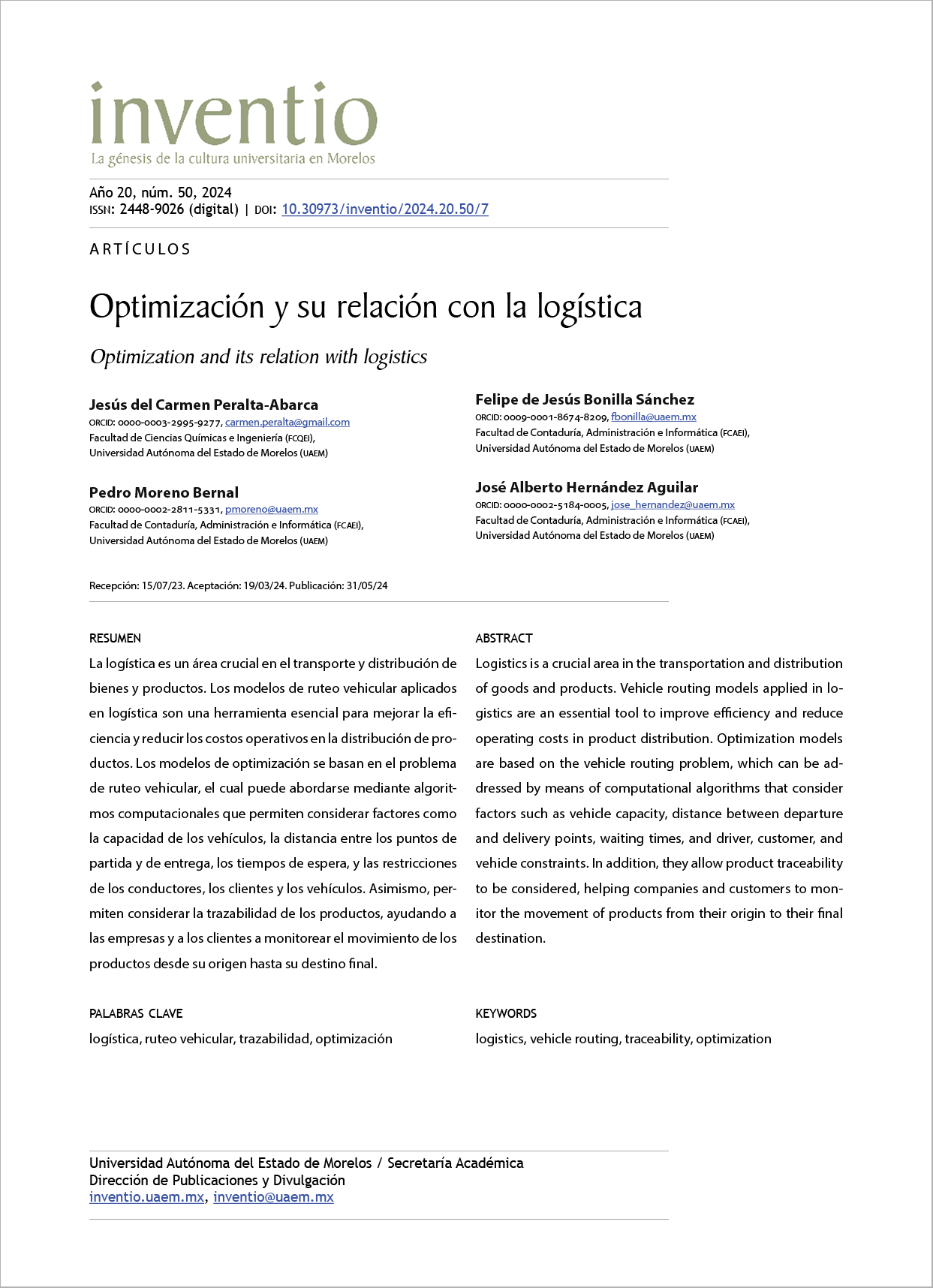
Logistics plays a critical role in transporting and distributing products and assets. Vehicle routing models are essential in logistics to enhance efficiency and reduce operating costs in product distribution. Optimization models are based on the vehicle routing problem, which computational optimization algorithms can address. These algorithms consider factors such as vehicle capacity, distance between departure and delivery points, waiting times, and driver, customer, and vehicle constraints. Furthermore, optimization algorithms enable consideration of product traceability, which helps companies and customers track the movement of products from their origin to their final destination.
References
Ballou, R. H. (2004). Logística: administración de la cadena de suministro. Pearson Educación. https://books.google.co.ve/books?id=ii5xqLQ5VLgC&printsec=frontcover#v=onepage&q&f=false
Bochtis, D. D. y Sørensen, C. G. (2009). The vehicle routing problem in field logistics: part I. Biosystems engineering, 104(4), 447-457. https://doi.org/10.1016/j.biosystemseng.2009.09.003
Casino, F., Kanakaris, V., Dasaklis, T. K., Moschuris, S., Stachtiaris, S., Pagoni, M. y Rachaniotis, N. P. (2021). Blockchain-based food supply chain traceability: a case study in the dairy sector. International Journal of Production Research, 59(19), 5758-5770. https://doi.org/10.1080/00207543.2020.1789238
Coello Coello, C. A., Lamont, G. B. y Van Veldhuizen, D. A. (2007). Evolutionary algorithms for solving multi-objective problems (vol. V, serie Genetic algorithms and evolutionary computation, D. E. Goldberg y J. R. Koza, eds.). Springer. https://link.springer.com/book/10.1007/978-0-387-36797-2
Dantzig, G. B. (1998). Linear programming and extensions (pp. 94, 308). Princeton University Press. https://www.rand.org/pubs/reports/R366.html
Dorigo, M. y Stützle, T. (2004). Ant colony optimization. Bradford Books. https://web2.qatar.cmu.edu/~gdicaro/15382/additional/aco-book.pdf
Hillier, F. S. y Lieberman, G. J. (2010). Introducción a la investigación de operaciones (pp. 5, 283, 351, 368). McGraw-Hill, 9a ed.
Kim, G., Ong, Y. S., Heng, C. K., Tan, P. S. y Zhang, N. A. (2015). City vehicle routing problem (city VRP): a review. IEEE Transactions on Intelligent Transportation Systems, 16(4), 1654-1666. https://doi.org/10.1109/TITS.2015.2395536
Konstantakopoulos, G. D., Gayialis, S. P. y Kechagias, E. P. (2020). Vehicle routing problem and related algorithms for logistics distribution: a literature review and classification. Operational Research, 22, 2033-2062. https://doi.org/10.1007/s12351-020-00600-7
Labadie, N., Prins, C. y Prodhon, C. (2016). Metaheuristics for vehicle routing problems. Wiley. https://doi.org/10.1007/978-3-319-45403-0_15
Laporte, G. (1992). The vehicle routing problem: an overview of exact and approximate algorithms. European Journal of Operational Research, 59(3), 345-358. https://doi.org/10.1016/0377-2217(92)90192-C
Liberatore, F., Righini, G. y Salani, M. (2011). A column generation algorithm for the vehicle routing problem with soft time windows. 4OR-Q J Oper Res, 9, 49-82. https://doi.org/10.1007/s10288-010-0136-6
Michalewicz, Z. y Fogel, D. B. (2013). How to solve it: modern heuristics (p. 76). Springer. https://link.springer.com/book/10.1007/978-3-662-07807-5
Modares, A., Somhom, S. y Enkawa, T. (1999), A self-organizing neural network approach for multiple traveling salesman and vehicle routing problems. International Transactions in Operational Research, 6(6), 591-606. https://doi.org/10.1016/S0969-6016(99)00015-5
Peralta-Abarca, J. del C. (2021). Metaheurísticas. Inventio, 14(34), 25-32. http://dx.doi.org/10.30973/inventio/2018.14.34
Rizzoli, A. E., Montemanni, R., Lucibello, E. y Gambardella, L. M. (2007). Ant colony optimization for real-world vehicle routing problems. From theory to applications. Swarm Intelligence, 1(2), 135-151. https://doi.org/10.1007/s11721-007-0005-x
Rossit, D. G. y Nesmachnow, S. (2022). Waste bins location problem: a review of recent advances in the storage stage of the Municipal Solid Waste reverse logistic chain. Journal of Cleaner Production, 342, 1-30. https://doi.org/10.48550/arXiv.2202.13754
Rossit, D. G., Toutouh, J. y Nesmachnow, S. (2020). Exact and heuristic approaches for multi-objective garbage accumulation points location in real scenarios. Waste Management, 105, 467-481. https://doi.org/10.48550/arXiv.2103.04826
Souali, K., Rahmaoui, O. y Ouzzif, M. (2016). An overview of traceability: definitions and techniques. 4th IEEE International Colloquium on Information Science and Technology, 789-793. https:///doi.org/10.1109/CIST.2016.7804995
Tarantilis, C. D. y Kiranoudis, C. T. (2005). Operational Research and food logistics. Journal of Food Engineering, 70(3), 253-255. http://dx.doi.org/10.1016/j.jfoodeng.2004.10.001
Toth, P. y Vigo, D. (2014). Vehicle routing: problems, methods, and applications. SIAM, 1-2. https://doi.org/10.1137/1.9781611973594
Downloads
Published
Issue
Section
License
Copyright (c) 2005 Jesús del Carmen Peralta-Abarca, Pedro Moreno Bernal, Felipe de Jesús Bonilla Sánchez, José Alberto Hernández Aguilar

This work is licensed under a Creative Commons Attribution-NonCommercial 4.0 International License.
Esta revista proporciona acceso abierto inmediato a su contenido, con base en el principio de ofrecer al público un acceso libre a las investigaciones para contribuir a un mayor intercambio global de conocimientos. Se distribuye bajo una licencia Creative Commons Reconocimiento-NoComercial 4.0 Internacional License.