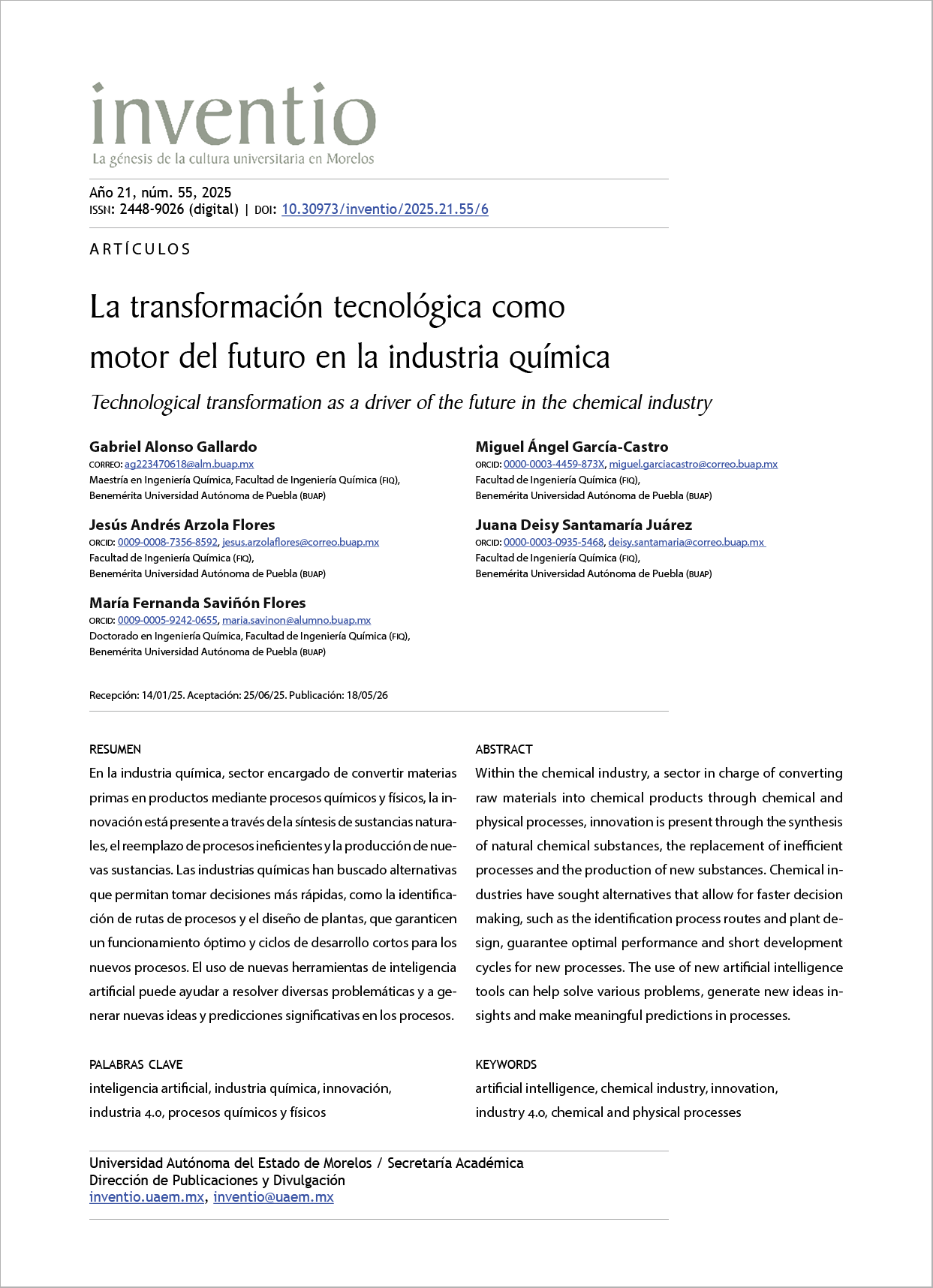
La transformación tecnológica como motor del futuro en la industria química
DOI:
https://doi.org/10.30973/inventio/2025.21.55/6Palabras clave:
inteligencia artificial, industria química, innovación, industria 4.0, procesos químicos, procesos físicosResumen
Dentro de la industria química, sector encargado de convertir materias primas en productos químicos mediante procesos químicos y físicos, la innovación está presente a través de la síntesis de sustancias naturales, el reemplazo de procesos ineficientes y la producción de nuevas sustancias. Las industrias químicas han buscado alternativas que permitan tomar decisiones más rápidas, como la identificación de rutas de procesos y el diseño de plantas, que garanticen un funcionamiento óptimo y ciclos de desarrollo cortos para los nuevos procesos. El uso de nuevas herramientas de inteligencia artificial puede ayudar a resolver diversas problemáticas y a generar nuevas ideas y predicciones significativas en los procesos.
Referencias
Al-Sheikh, M., Medrasi, H. Y., Usef Sadek, K. y Mekheimer, R. A. (2014). Synthesis and spectroscopic properties of new azo dyes derived from 3-ethylthio-5-cyanomethyl-4-phenyl-1,2,4-triazole. Molecules, 19(3), 2993-3003. https://doi.org/10.3390/molecules19032993
Artz, J., Müller, T. E., Thenert, K., Kleinekorte, J., Meys, R., Sternberg, A., Bardow, A. y Leitner, W. (2017). Sustainable conversion of carbon dioxide: an integrated review of catalysis and life cycle assessment. Chemical Reviews, 118(2), 434-504. https://doi.org/10.1021/acs.chemrev.7b00435
Attaran, S., Attaran, M. y Celik, B. G. (2024). Digital twins and industrial Internet of Things: uncovering operational intelligence in industry 4.0. Decision Analytics Journal, 10, 100398. https://doi.org/10.1016/j.dajour.2024.100398
Bai, C., Dallasega, P., Orzes, G. y Sarkis, J. (2020). Industry 4.0 technologies assessment: a sustainability perspective. International Journal of Production Economics, 229, 107776. https://doi.org/10.1016/j.ijpe.2020.107776
Dadhaneeya, H., Nema, P. K. y Arora, V. K. (2023). Internet of things in food processing and its potential in industry 4.0 era: a review. Trends in Food Science & Technology, 139, 104109. https://doi.org/10.1016/j.tifs.2023.07.006
European Commission y Directorate-General for Research and Innovation (2022). Industry 5.0, a transformative vision for Europe. Governing systemic transformations towards a sustainable industry. ESIR Policy Brief No. 3. Publications Office of the European Union. https://op.europa.eu/en/web/eu-law-and-publications/publication-detail/-/publication/38a2fa08-728e-11ec-9136-01aa75ed71a1
European Commission y Directorate-General for Research and Innovation (2021). Industry 5.0. Towards a sustainable, human-centric, and resilient European industry. Publications Office of the European Union. https://op.europa.eu/en/publication-detail/-/publication/468a892a-5097-11eb-b59f-01aa75ed71a1/
Ghobakhloo, M., Mahdiraji, H. A., Iranmanesh, M. y Jafari-Sadeghi, V. (2024). From Industry 4.0 digital manufacturing to Industry 5.0 digital society: a roadmap toward human-centric, sustainable, and resilient production. Information Systems Frontiers, 1-33. https://doi.org/10.1007/s10796-024-10476-z
Kätelhön, A., Meys, R., Deutz, S., Suh, S. y Bardow, A. (2019). Climate change mitigation potential of carbon capture and utilization in the chemical industry. Proceedings of the National Academy Sciences, 116(23), 11187-11194. https://doi.org/10.1073/pnas.1821029116
Kumar, P. (2007). Plantation science: improving natural indigo in colonial India, 1860-1913. The British Journal for the History of Science, 40(4), 537-565. https://doi.org/10.1017/S0007087407000027
Lapkin, A. A. (2018). Chemical engineering science and green chemistry – the Challenge of Sustainability. En A. Lapkin (ed.), Handbook of Green Chemistry (vol. 12: Green Chemical Engineering, pp. 1-16). Wiley-VCH. https://books.google.com.mx/books?id=7ExjDwAAQBAJ&printsec=frontcover&hl=es&source=gbs_ge_summary_r&cad=0#v=onepage&q&f=false
Linchevski, C. (2021). How to leverage AI to benefit the chemical industry. Chemie Ingenieur Technik, 93(12), 2040-2044. https://doi.org/10.1002/cite.202100099
Majee, S., Shilpa, Sarav, M., Banik, B. K. y Ray, D. (2023). Recent advances in the green synthesis of active N-heterocycles and their biological activities. Pharmaceuticals, 16(6), 873. https://doi.org/10.3390/ph16060873
Manavalan, E. y Jayakrishna, K. (2019). A review of Internet of Things (IoT) embedded sustainable supply chain for industry 4.0 requirements. Computers & Industrial Engineering, 127, 925-953. https://doi.org/10.1016/j.cie.2018.11.030
Murmann, J. P. (2002). Chemical industries after 1850. Oxford Encyclopedia of Economic History. Oxford University Press. https://www.alexandria.unisg.ch/entities/publication/aabb2c3a-69e9-4af0-95a3-b64e112e0d9b
Nahavandi, S. (2019). Industry 5.0—A human-centric solution. Sustainability, 11(16), 4371. https://doi.org/10.3390/su11164371
Olsen, T. L. y Tomlin, B. (2019). Industry 4.0: opportunities and challenges for operations management. Manufacturing & Service Operations Management, 22(1), 113-122. https://doi.org/10.1287/msom.2019.0796
Panter, L., Leder, R., Keiser, D. y Freitag, M. (2024). Requirements for human-machine interaction applications in production and logistics within Industry 5.0 – a case study approach. Procedia Computer Science, 232, 1164-1171. https://doi.org/10.1016/j.procs.2024.01.114
Ramos Robles, M. D. (2015). Proceso de Haber-Bosch. Síntesis de amoníaco. MoleQla: revista de Ciencias de la Universidad Pablo de Olavide, (17), 7-3. https://dialnet.unirioja.es/servlet/articulo?codigo=5015875
Rodríguez Guarnizo, J. y Rodríguez Barrantes, D. (1999). Los procedimientos clásicos de fabricación de la sosa. Ensayos. Revista de la Facultad de Educación de Albacete, (14), 293-310. https://dialnet.unirioja.es/servlet/articulo?codigo=2292804
Sass, S., Faulwasser, T., Hollermann, D. E., Kappatou, C. D., Sauer, D., Schütz, T., Shu, D. Y., Bardow, A., Gröll, L., Hagenmeyer, V., Müller, D. y Mitsos, A. (2018). Model compendium, data, and optimization benchmarks for sector-coupled energy systems. Computers & Chemical Engineering, 113, 106760. https://doi.org/10.1016/j.compchemeng.2020.106760
Schwab, K. (2016). The fourth industrial revolution. World Economic Forum, sp. https://www.weforum.org
Schweidtmann, A. M., Esche, E., Fischer, A., Kloft, M., Repke, J.-U., Sager, S. y Mitsos, A. (2021). Machine learning in chemical engineering: a perspective. Chemie Ingenieur Technik, 93(12), 2029-2039. https://doi.org/10.1002/cite.202100083
Smil, V. (2004). Enriching the earth. Fritz Haber, Carl Bosch, and the Transformation of World Food Production. MIT Press.
Xu, Y., Sun, Y., Liu, X. y Zheng, Y. (2019). A digital-twin-assisted fault diagnosis using deep transfer learning. IEEE Access, 7, 19990-19999. https://doi.org/10.1109/access.2018.2890566
Publicado
Número
Sección
Licencia
Derechos de autor 2026 Gabriel Alonso Gallardo, Jesús Andrés Arzola Flores, María Fernada Saviñón Flores, Miguel Ángel García Castro, Juana Deysi Santamaría Juárez

Esta obra está bajo una licencia internacional Creative Commons Atribución-NoComercial 4.0.
Esta revista proporciona acceso abierto inmediato a su contenido, con base en el principio de ofrecer al público un acceso libre a las investigaciones para contribuir a un mayor intercambio global de conocimientos. Se distribuye bajo una licencia Creative Commons Reconocimiento-NoComercial 4.0 Internacional License.