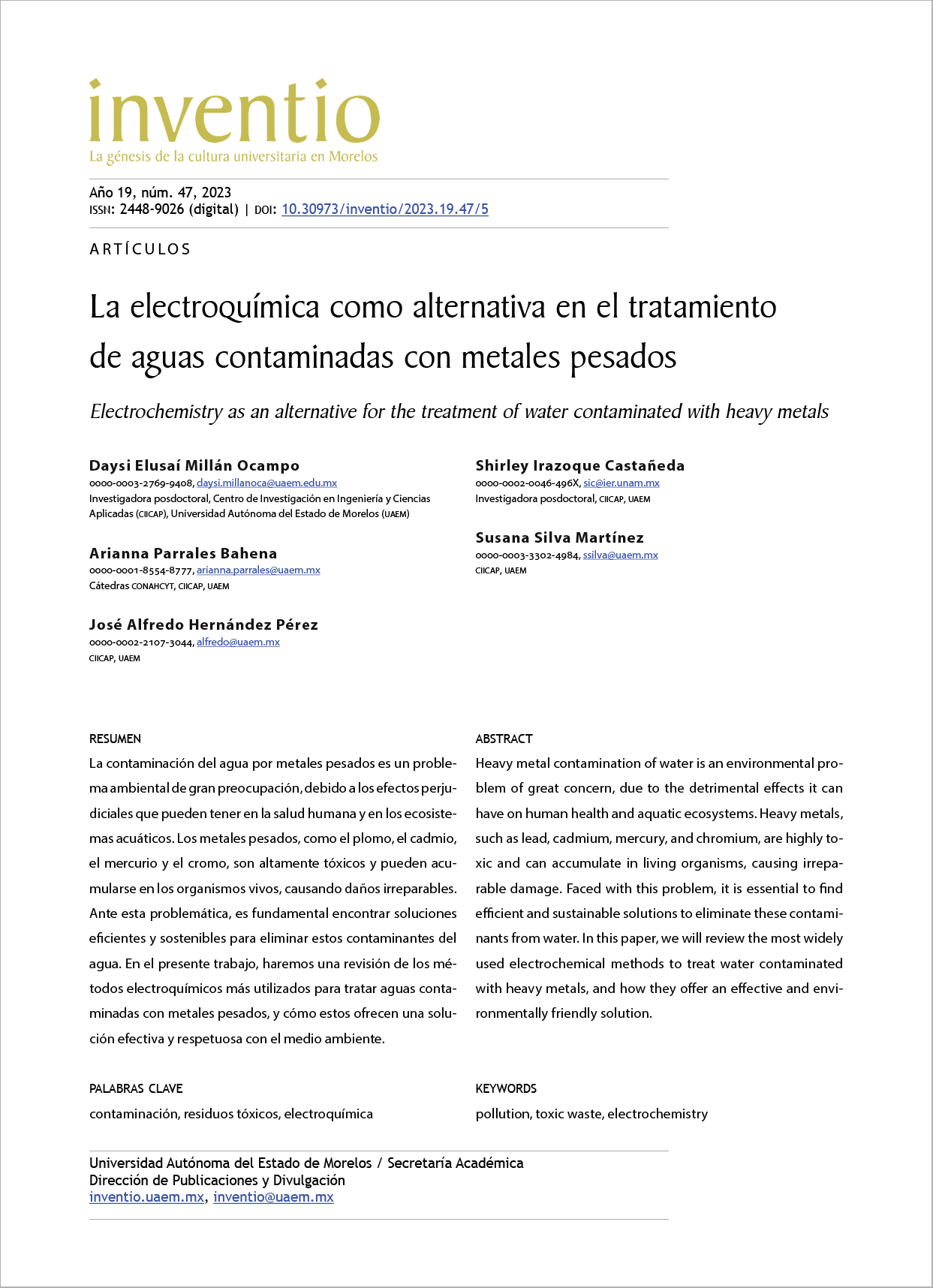
Electrochemistry as an alternative for the treatment of water contaminated with heavy metals
DOI:
https://doi.org/10.30973/inventio/2023.19.47/5Keywords:
pollution, toxic waste, electrochemistryAbstract
Heavy metal contamination of water is an environmental problem of great concern, due to the detrimental effects it can have on human health and aquatic ecosystems. Heavy metals, such as lead, cadmium, mercury, and chromium, are highly toxic and can accumulate in living organisms, causing irreparable damage. Faced with this problem, it is essential to find efficient and sustainable solutions to eliminate these contaminants from water. In this paper, we will review the most widely used electrochemical methods to treat water contaminated with heavy metals, and how they offer an effective and environmentally friendly solution.
References
Al-Saydeh, S. A., El-Naas, M. H. y Zaidi, S. J. (2017). Copper removal from industrial wastewater: a comprehensive review. Journal of Industrial and Engineering Chemistry, 56, 35-44. https://doi.org/10.1016/j.jiec.2017.07.026
Ali, I., Alyona, S., Tatiana, K., Anastasiya, G., Albishri, H. M. y Alshitari, W. H. (2023). Facile adsorption-electroflotation method for the removal of heavy metal ions from water using carbon nanomaterials. Environmental Science and Pollution Research, 30, 38970-38981. https://doi.org/10.1007/s11356-022-24509-0
Ano, J., Koné, H., Yapo, N. S., Drogui, P., Yao, K. y Adouby, K. (2023). Removal of copper and lead by electrocoagulation process: effects of experimental parameters and optimization with full factorial designs. J. Mater. Environ. Sci, 14(2), 173-183. https://www.jmaterenvironsci.com/Document/vol14/vol14_N2/JMES-2023-14013-Ano.pdf
Arana Juve, J. M., Christensen, F. M. S., Wang, Y. y Wei, Z. (2022). Electrodialysis for metal removal and recovery: A review. Chemical Engineering Journal, 435, 1-20. https://doi.org/10.1016/j.cej.2022.134857
Azimi, A., Azari, A., Rezakazemi, M. y Ansarpour, M. (2017). Removal of Heavy Metals from Industrial Wastewaters: A Review. ChemBioEng Reviews, 4(1), 37-59. https://doi.org/10.1002/cben.201600010
Barakat, M. A. (2011). New trends in removing heavy metals from industrial wastewater. Arabian Journal of Chemistry, 4, 361-377. https://doi.org/10.1016/j.arabjc.2010.07.019
Carolin, C. F., Kumar, P. S., Saravanan, A., Joshiba, G. J. y Naushad, M. (2017). Efficient techniques for the removal of toxic heavy metals from aquatic environment: A review. Journal of Environmental Chemical Engineering, 5(3), 2782-2799. https://doi.org/10.1016/j.jece.2017.05.029
Ciszewski, M., Drzazga, M., Kowalik, P., Orda, S. y Hawełek, Ł. (2022). Lead electrodeposition from aliphatic polyamines solutions. SN Applied Sciences, 4(4). https://doi.org/10.1007/s42452-022-05020-0
Diario Oficial de la Federación (2000). NOM-127-SSA1-1994: Salud ambiental. Agua para uso y consumo humano. Límites permisibles de calidad y tratamientos a los quedebe someterse el agua para su potabilización. Diario Oficial de la Federación, 73l78. https://dof.gob.mx/nota_detalle.php?codigo=4866379&fecha=18/01/1996
Diario Oficial de la Federación (2014). NOM-002-SEMARNAT-1996: Límites máximos permisibles de contaminantes en las descargas de aguas residuales en aguas y bienes nacionales. Diario Oficial de la Federación, 1-66. https://dof.gob.mx/nota_detalle.php?codigo=4881304&fecha=03/06/1998#gsc.tab=0
Driscoll, C. T., Mason, R. P., Chan, H. M., Jacob, D. J. y Pirrone, N. (2013). Mercury as a global pollutant: Sources, Pathways, and Effects. Environmental Science and Technology, 47(10), 4967-4983. https://doi.org/10.1021/es305071v
Haider, F. U., Liqun, C., Coulter, J. A., Cheema, S. A., Wu, J., Zhang, R., Wenjun, M. y Farooq, M. (2021). Cadmium toxicity in plants: Impacts and remediation strategies. Ecotoxicology and Environmental Safety, 211, 1-22. https://doi.org/10.1016/j.ecoenv.2020.111887
Higgs, J. M., Bingham, B. R. y Boyer, R. (2022). Alternating Current for the Selective Electrodeposition of Cadmium, Iron, and Chromium Method Development for Simulated Industrial Wastewater Sludge. International Journal of Water and Wastewater Treatment, 8(1), 1-5. https://doi.org/10.16966/2381-5299.182
Holt, P. K., Barton, G. W., Wark, M. y Mitchell, C. A. (2002). A quantitative comparison between chemical dosing and electrocoagulation. Colloids and Surfaces, 211, 233-248. https://doi.org/10.1016/S0927-7757(02)00285-6
Hu, J., Chen, C., Zhu, X. y Wang, X. (2009). Removal of chromium from aqueous solution by using oxidized multiwalled carbon nanotubes. Journal of Hazardous Materials, 162(2-3), 1542-1550. https://doi.org/10.1016/j.jhazmat.2008.06.058
Khattab, I. A., Shaffei, M. F., Shaaban, N. A., Hussein, H. S. y Abd El-Rehim, S. S. (2013). Electrochemical removal of copper ions from dilute solutions using packed bed electrode. Part ІІ. Egyptian Journal of Petroleum, 22(1), 205-210. https://doi.org/10.1016/j.ejpe.2012.09.012
Kim, J., Yoon, S., Choi, M., Min, K. J., Park, K. Y., Chon, K. y Bae, S. (2022). Metal ion recovery from electrodialysis-concentrated plating wastewater via pilot-scale sequential electrowinning/chemical precipitation. Journal of Cleaner Production, 330, 1-9. https://doi.org/10.1016/j.jclepro.2021.129879
Kong, Y., Wei, J., Wang, Z., Sun, T., Yao, C. y Chen, Z. (2011). Heavy metals removal from solution by polyaniline/palygorskite composite. Journal of Applied Polymer Science, 122(3), 2054-2059. https://doi.org/10.1002/app.34195
Kuleyin, A. y Uysal, H. E. (2020). Recovery of copper ions from industrial wastewater by electrodeposition. International Journal of Electrochemical Science, 15(2), 1474-1485. https://doi.org/10.20964/2020.02.39
Kurniawan, T. A., Chan, G. Y. S., Lo, W. H. y Babel, S. (2006). Physico-chemical treatment techniques for wastewater laden with heavy metals. Chemical Engineering Journal, 118(1-2), 83-98. https://doi.org/10.1016/j.cej.2006.01.015
Maarof, H. I., Daud, W. M. A. W. y Aroua, M. K. D. (2017). Recent trends in removal and recovery of heavy metals from wastewater by electrochemical technologies. Reviews in Chemical Engineering, 33, 359-386. https://doi.org/10.1515/revce-2016-0021
Merzouk, B., Gourich, B., Sekki, A., Madani, K. y Chibane, M. (2009). Removal turbidity and separation of heavy metals using electrocoagulation-electroflotation technique. A case study. Journal of Hazardous Materials, 164(1), 215-222. https://doi.org/10.1016/j.jhazmat.2008.07.144
Meunier, N., Drogui, P., Montané, C., Hausler, R., Mercier, G. y Blais, J. F. (2006). Comparison between electrocoagulation and chemical precipitation for metals removal from acidic soil leachate. Journal of Hazardous Materials, 137(1), 581-590. https://doi.org/10.1016/j.jhazmat.2006.02.050
Özverdi, A. y Erdem, M. (2006). Cu2+, Cd2+ and Pb2+ adsorption from aqueous solutions by pyrite and synthetic iron sulphide. Journal of Hazardous Materials, 137, 626-632. https://doi.org/10.1016/j.jhazmat.2006.02.051
Prieto-García, F., Callejas-Hernández, J., Reyes-Cruz, V. E., Marmolejo-Santillán, Y. y Prieto-Méndez, J. (2014). Electrodissolution aluminum electrode during an electrocoagulation acid whey. DYNA (Colombia), 81(187), 129-136. https://doi.org/10.15446/dyna.v81n187.40757
Qasem, N. A. A., Mohammed, R. H. y Lawal, D. U. (2021). Removal of heavy metal ions from wastewater: a comprehensive and critical review. Clean Water, 4(1), 1-15. https://doi.org/10.1038/s41545-021-00127-0
Sadegh Safarzadeh, M., Bafghi, M. S., Moradkhani, D.y y Ojaghi Ilkhchi, M. (2007). A review on hydrometallurgical extraction and recovery of cadmium from various resources. Minerals Engineering, 20(3), 211-220. https://doi.org/10.1016/j.mineng.2006.07.001
Sandstead, H. (1975). Some trace elements which are esscential for human nutrition. Progress in Food and Nutrition Science, 1, 371-391.
Scarazzato, T., Panossian, Z., Tenório, J. A. S., Pérez-Herranz, V. y Espinosa, D. C. R. (2017). A review of cleaner production in electroplating industries using electrodialysis. Journal of Cleaner Production, 168, 1590-1602. https://doi.org/10.1016/j.jclepro.2017.03.152
Scott, W. W. (2001). ASM Specialty Handbook ® Copper and Copper Alloys (Davis & Associates [ed.]; 1st ed.). ASM International. http://www.asminternational.org
Shrestha, R., Ban, S., Devkota, S., Sharma, S., Joshi, R., Tiwari, A. P., Kim, H. Y. y Joshi, M. K. (2021). Technological trends in heavy metals removal from industrial wastewater: A review. Journal of Environmental Chemical Engineering, 9(4), 2213-3437. https://doi.org/10.1016/j.jece.2021.105688
Solomons, N. W. (1985). Biochemical, Metabolic, and Clinical Role of Copper in Human Nutrition. Journal of the American College of Nutrition, 4(1), 83-105. https://doi.org/10.1080/07315724.1985.10720069
Vargas, A. R., Guillén, C. S., Magaña Haynes, M. E. y AlJaberi, F. Y. (2023). Nickel removal from an industrial effluent by electrocoagulation in semi-continuous operation: Hydrodynamic, kinetic and cost analysis. Results in Engineering, 17, 1-14. https://doi.org/10.1016/j.rineng.2023.100961
Vasudevan, S. y Lakshmi, J. (2011). Effect of alternating and direct current in an electrocoagulation process on the removal of cadmium from water. Separation and Purification Technology, 80, 643-651. https://doi.org/10.2166/wst.2012.859
Yi, Y., Feng, H., Wang, J., Tang, J., Wu, Y., Liang, X., Guo, Y. y Tang, L. (2022). Simultaneous Recovery of NH3-N and Removal of Heavy Metals from Manganese Residue Leachate Using an Electrodialysis System. ACS ES and T Water, 3, 793-803. https://doi.org/10.1021/acsestwater.2c00580
Yu, B., Zhang, Y., Shukla, A., Shukla, S. S., & Dorris, K. L. (2000). The removal of heavy metal from aqueous solutions by sawdust adsorption-removal of copper. Journal of Hazardous Materials, 80. https://doi.org/10.1016/S0304-3894(00)00278-8
Zamora-Ledezma, C., Negrete-Bolagay, D., Figueroa, F., Zamora-Ledezma, E., Ni, M., Alexis, F. y Guerrero, V. H. (2021). Heavy metal water pollution: A fresh look about hazards, novel and conventional remediation methods. Environmental Technology and Innovation, 22, 101504. https://doi.org/10.1016/j.eti.2021.101504
Zhu, Y., Fan, W., Zhou, T. y Li, X. (2019). Removal of chelated heavy metals from aqueous solution: A review of current methods and mechanisms. Science of the Total Environment, 678, 253-266. https://doi.org/10.1016/j.scitotenv.2019.04.416
Downloads
Published
Issue
Section
License
Copyright (c) 2005 Daysi Elusaí Millán Ocampo, Arianna Parrales Bahena, José Alfredo Hernández Pérez, Shirley Irazoque Castañeda, Susana Silva Martínez

This work is licensed under a Creative Commons Attribution-NonCommercial 4.0 International License.
Esta revista proporciona acceso abierto inmediato a su contenido, con base en el principio de ofrecer al público un acceso libre a las investigaciones para contribuir a un mayor intercambio global de conocimientos. Se distribuye bajo una licencia Creative Commons Reconocimiento-NoComercial 4.0 Internacional License.