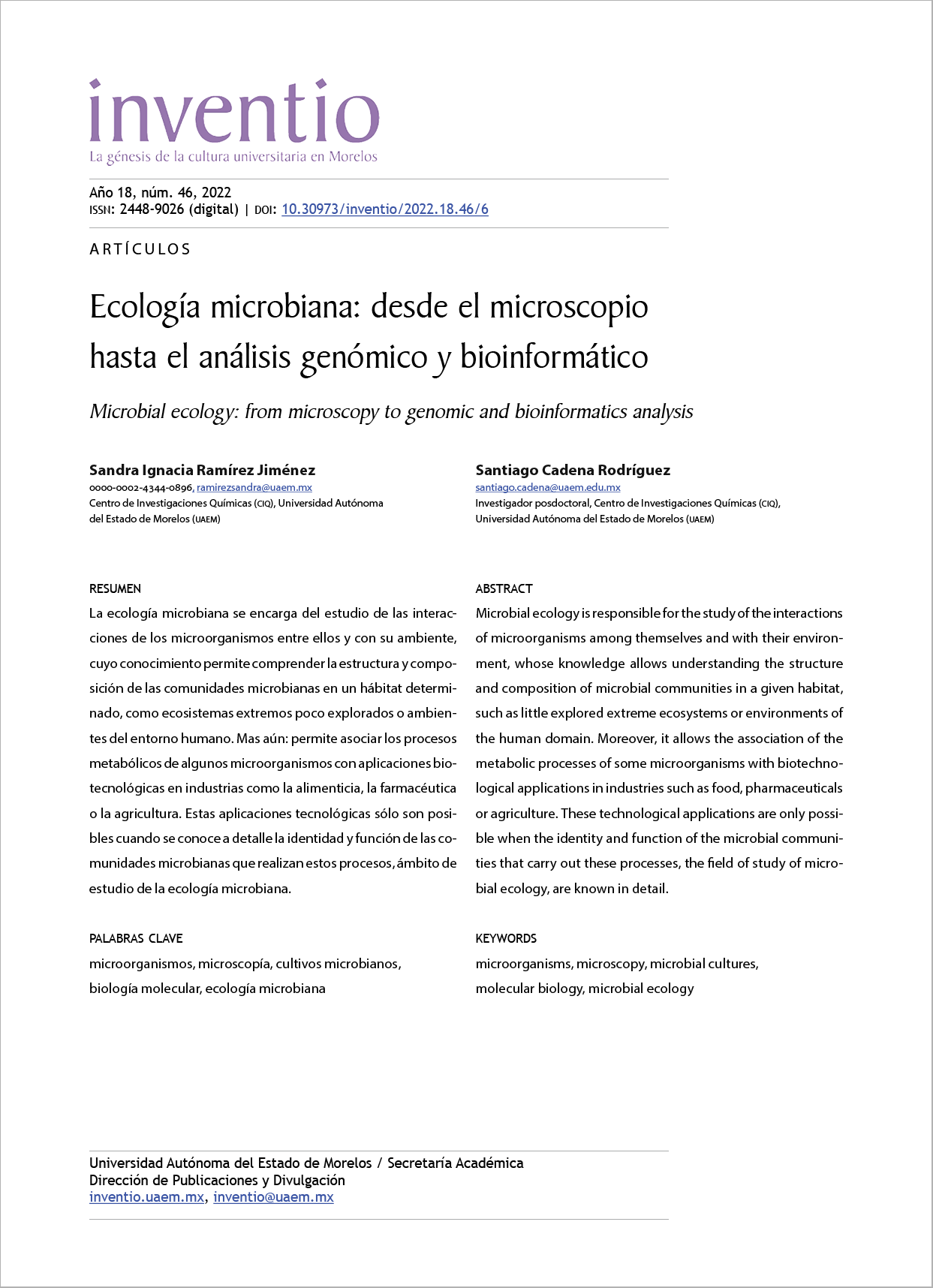
Microbial ecology: from microscopy to genomic and bioinformatics analysis
DOI:
https://doi.org/10.30973/inventio/2022.18.46/6Keywords:
microorganism, microscopy, microbial cultures, molecular biology, microbial ecologyAbstract
Microbial ecology is responsible for the study of the interactions of microorganisms among themselves and with their environment, whose knowledge allows understanding the structure and composition of microbial communities in a given habitat, such as little explored extreme ecosystems or environments of the human domain. Moreover, it allows the association of the metabolic processes of some microorganisms with biotechnological applications in industries such as food, pharmaceuticals or agriculture. These technological applications are only possible when the identity and function of the microbial communities that carry out these processes, the field of study of microbial ecology, are known in detail.
References
Adam, P. S., Borrel, G., Brochier-Armanet, C. y Gribaldo, S. (2017). The growing tree of Archaea: New perspectives on their diversity, evolution and ecology. ISME Journal, 11, 2407-2425. https://doi.org/10.1038/ismej.2017.122
Brock, T. D. (1997). The value of basic research: Discovery of Thermus aquaticus and other extreme thermophiles. Genetics, 4(146), 1207-1210. https://doi.org/10.1093/genetics/146.4.1207
Esakandari, H., Nabi-Afjadi, M., Fakkari-Afjadi, J., Farahmandian, N., Miresmaeili, S.-M. y Bahreini, E. (2020). A comprehensive review of COVID-19 characteristics. Biological Procedures Online 22, 1-10. https://doi.org/10.1186/s12575-020-00128-2
Falkowski, P. G., Fenchel, T. y Delong, E. F. (2008). The microbial engines that drive earth’s biogeochemical cycles. Science, 80(320), 1034-1039. https://doi.org/10.1126/science.1153213
Flemming, H. C. y Wuertz, S. (2019). Bacteria and archaea on Earth and their abundance in biofilms. Nature Reviews Microbiology, 17, 247-260. https://doi.org/10.1038/s41579-019-0158-9
Gilbert, J. A., Jansson, J. K. y Knight, R. (2014). The Earth Microbiome project: Successes and aspirations. BMC Biology, 12, 1-4. https://doi.org/10.1186/s12915-014-0069-1
Hernández, M., Quijada, N. M., Rodríguez-Lázaro y Eiros, J. M, (2020). Bioinformatics of next generation sequencing in clinical microbiology diagnosis. Revista Argentina de Microbiología, 2(52), 150-161. https://doi.org/10.1016/j.ram.2019.06.003
Jiao, J.-Y., Liu, L., Hua, Z.-S., Fang, B.-Z., Zhou, E.-M., Salam, N., Hedlund, B. P. y Li, W.-J. (2021). Microbial dark matter coming to light: Challenges and opportunities. National Science Review, 3(8), 1-5. https://doi.org/10.1093/nsr/nwaa280
Karamanou, M., Poulakou-Rebelakou, E., Tzetis, M. y Androutsos, G. (2010). Anton van Leeuwenhoek (1632-1723): Father of micromorphology and discoverer of spermatozoa. Revista Argentina de Microbiología, 42, 311-314. https://www.redalyc.org/articulo.oa?id=213016779013
Knight, R., Jansson, J., Field, D., Fierer, N., Desai, N., Fuhrman, J. A., Hugenholtz, P., van der Lelie, D., Meyer, F., Stevens, R., Bailey, M. J., Gordon, J. I., Kowalchuk, G. A. y Gilbert, J. A. (2012). Unlocking the potential of metagenomics through replicated experimental design. Nature Biotechnology, 30(6), 513-520. https://doi.org/10.1038/nbt.2235
Kruif, P. D. (1997). Cazadores de microbios. Editora Géminis.
Madigan, M. T., Martinko, J. M., Bender, K. S., Buckley, D. H. y Stahl, D. A. (2004). Brock: Biología de los microorganismos (10ª ed.). Pearson Educación.
Marzorati, M., Wittebolle, L., Boon, N., Daffonchio, D. y Verstraete, W. (2008). How to get more out of molecular fingerprints: Practical tools for microbial ecology. Environmental Microbiology, 6(10), 1571-1581. https://doi.org/10.1111/j.1462-2920.2008.01572.x
Parks, D. H., Chuvochina, M., Waite, D. W., Rinke, C., Skarshewski, A., Chaumeil, P.-A. y Hugenholtz, P. (2018). A standardized bacterial taxonomy based on genome phylogeny substantially revises the tree of life. Nature Biotechnology, 36, 996. https://doi.org/10.1038/nbt.4229
Patwardhan, A., Ray, S. y Roy, A. (2014). Molecular markers in phylogenetic studies—A Review. Journal of Phylogenetics and Evolutionary Biology, 2(2), 131. https://doi.org/10.4172/2329-9002.1000131
Pereira, R., Oliveira, J. y Sousa, M. (2020). Bioinformatics and computational tools for next-generation sequencing analysis in clinical genetics. Journal of Clinical Medicine, 9(1), 132. https://doi.org/10.3390/jcm9010132
Quast, C., Pruesse, E., Yilmaz, P., Gerken, J., Schweer, T., Yarza, P., Peplies, J. y Glöckner, F. O. (2013). The SILVA ribosomal RNA gene database project: Improved data processing and web-based tools. Nucleic Acids Research, D1(41), 590-596. https://doi.org/10.1093/nar/gks1219
Smith, K. (2007). Technological and economic dynamics of the world wine industry: An introduction. International Journal of Technology and Globalisation, 2-3(3), 127-137. https://doi.org/10.1504/ijtg.2007.014329
Stewart, E. J. (2012). Growing unculturable bacteria. Journal of Bacteriology, 16(194), 4151-4160. https://doi.org/10.1128/JB.00345-12
Sunagawa, S., Acinas, S. G., Bork, P., Bowler, C., Tara Oceans Coordinators, Eveillard, D., Gorsky, G., Guidi, L., Iudicone, D., Karsenti, E., Lombard, F., Ogata, H., Pesant, S., Sullivan, M. B., Wincker, P. y de Vargas, C. (2020). Tara Oceans: towards global ocean ecosystems biology. Nature Reviews Microbiology, 18, 428-445. https://doi.org/10.1038/s41579-020-0364-5
Valentini, A., Pompanon, F. y Taberlet, P. (2009). DNA barcoding for ecologists. Trends in Ecology and Evolution, 2(24), 110-117. https://doi.org/10.1016/j.tree.2008.09.011
Whitman, W. B., Coleman, D. C. y Wiebe, W. J. (1998). Prokaryotes: The unseen majority. PNAS, 95(12), 6578-6583. https://doi.org/10.1073/pnas.95.12.6578
Woese, C. R., Kandler, O. y Wheelis, M. L. (1990). Towards a natural system of organisms: Proposal for the domains Archaea, Bacteria, and Eucarya. PNAS, 87(12), 4576-4579. https://doi.org/10.1073/pnas.87.12.4576
Downloads
Published
Issue
Section
License
Copyright (c) 2005 Sandra Ignacia Ramírez Jiménez, Santiago Cadena

This work is licensed under a Creative Commons Attribution-NonCommercial 4.0 International License.
Esta revista proporciona acceso abierto inmediato a su contenido, con base en el principio de ofrecer al público un acceso libre a las investigaciones para contribuir a un mayor intercambio global de conocimientos. Se distribuye bajo una licencia Creative Commons Reconocimiento-NoComercial 4.0 Internacional License.