Malaria in birds
DOI:
https://doi.org/10.30973/inventio/2024.20.52/4Keywords:
Blood parasites, diseases, mosquitoes, protozoans, wildlifeAbstract
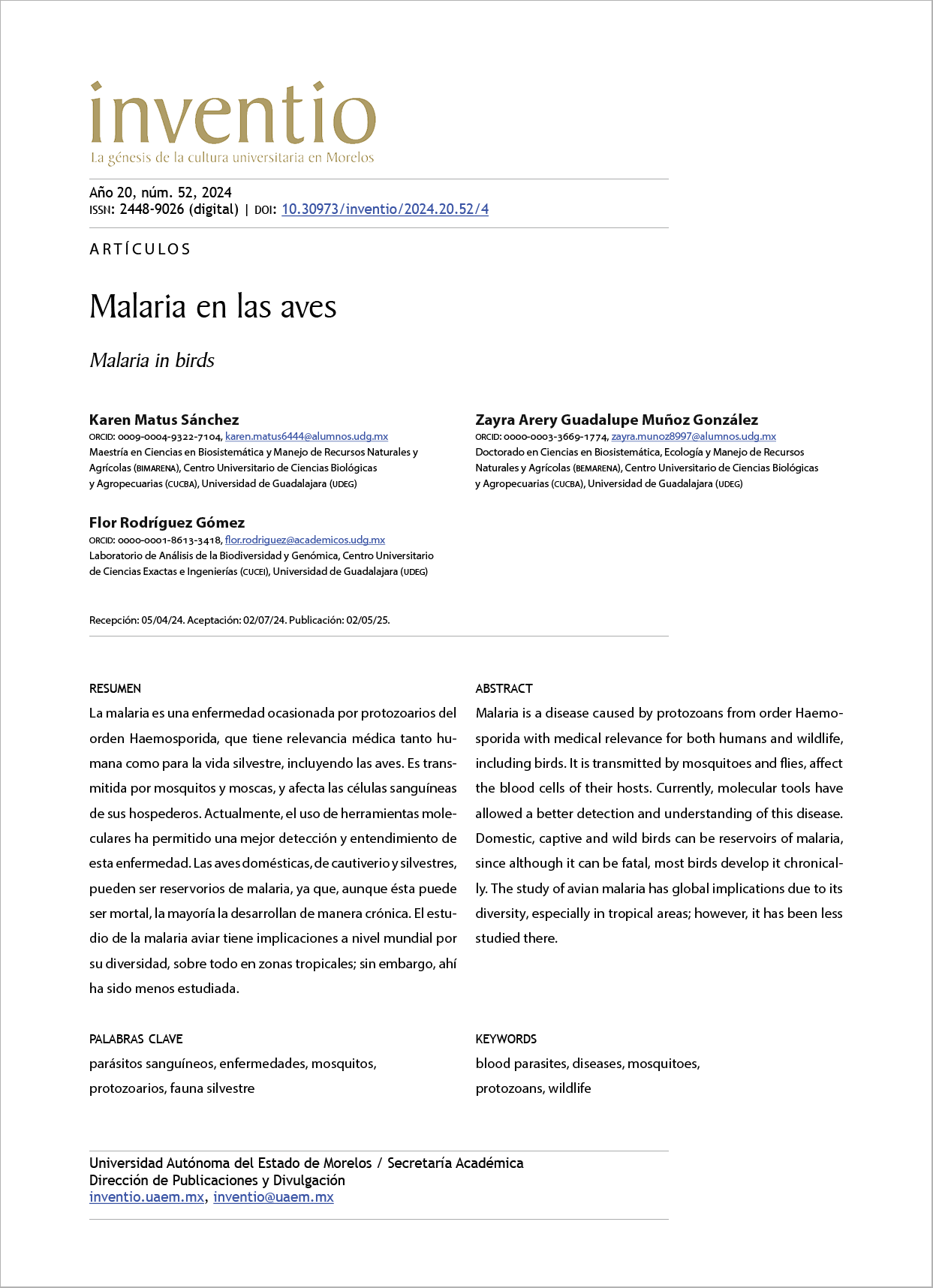
Malaria is a disease caused by protozoans from order Haemosporida with medical relevance for both humans and wildlife, including birds. It is transmitted by mosquitoes and flies, affect the blood cells of their hosts. Currently, molecular tools have allowed a better detection and understanding of this disease. Domestic, captive and wild birds can be reservoirs of malaria, since although it can be fatal, most birds develop it chronically. The study of avian malaria has global implications due to its diversity, especially in tropical areas; however, it has been less studied there.
References
Álvarez-Mendizábal, P., Villalobos, F., Rodríguez-Hernández, K., Hernández-Lara, C., Rico-Chávez, O., Suzán, G., Chapa-Vargas, L. y Santiago-Alarcón, D. (2021). Metacommunity structure reveals that temperature affects the landscape compositional patterns of avian malaria and related haemosporidian parasites across elevations. Acta Oecologica, 113, 103789. https://doi.org/10.1016/j.actao.2021.103789
Amaya-Mejía, W., Dodge, M., Morris, B., Dumbacher, J. P. y Sehgal, R. N. M. (2022). Prevalence and diversity of avian haemosporidian parasites across islands of Milne Bay Province, Papua New Guinea. Parasitology Research, 121(6), 1621-1630. https://doi.org/10.1007/s00436-022-07490-y
Atkinson, C. T. (2005). Ecology and diagnosis of introduced avian malaria in Hawaiian forest birds. Fact Sheet, 2005-3151, 1-4. https://doi.org/10.3133/fs20053151
Carlson, J. S., Martínez-Gómez, J. E., Cornel, A., Loiseau, C. y Sehgal, R. N. M. (2011). Implications of Plasmodium parasite infected mosquitoes on an insular avifauna: the case of Socorro Island, México. Journal of Vector Ecology, 36(1), 213-220. https://doi.org/10.1111/j.1948-7134.2011.00159.x
Chakarov, N., Veiga, J., Ruiz-Arrondo, I. y Valera, F. (2021). Atypical behavior of a black fly species connects cavity-nesting birds with generalist blood parasites in an arid area of Spain. Parasites & Vectors, 14, 1-9. https://doi.org/10.1186/s13071-021-04798-z
Garnham, P. C. C. (1966). Malaria parasites and other haemosporidia. Blackwell Scientific Public.
Jiménez-Peñuela, J., Ferraguti, M., Martínez de la Puente, J., Soriguer, R. C. y Figuerola, J. (2021). Urbanization effects on temporal variations of avian haemosporidian infections. Environmental Research, 199. https://doi.org/10.1016/j.envres.2021.111234
Jones, K., Johnson, N., Yang, S., Stokes, J., Smith, W., Wills, R., Goddard, J. y Varela- Stokes, A. (2014). Investigations into outbreaks of black fly attacks and subsequent avian haemosporidians in backyard-type poultry and other exposed avian species. Avian Diseases, 59(1), 24-30. https://doi.org/10.1637/10867-052114-Reg.1
Li, Z., Ren, X.-X., Zhao, Y.-J., Yang, L.-T., Duan, B.-F., Hu, N.-Y., Zou, F.-C., Zhu, X.-Q., He, J.-J. y Liu, Q.-S. (2022). First report of haemosporidia and associated risk factors in red junglefowl (Gallus gallus) in China. Parasites & Vectors, 15(1), 1-6. https://doi.org/10.1186/s13071-022-05389-2
Liao, W., Atkinson, C. T., LaPointe, D. A. y Samuel, M. D. (2017). Mitigating future avian malaria threats to Hawaiian forest birds from climate change. PLOS ONE, 12(1), e0168880. https://doi.org/10.1371/journal.pone.0168880
Liao, W., Elison Timm, O., Zhang, C., Atkinson, C. T., LaPointe, D. A. y Samuel, M. D. (2015). Will a warmer and wetter future cause extinction of native Hawaiian forest birds? Global Change Biology, 21(12), 4342-4352. https://doi.org/10.1111/gcb.13005
Martínez de la Puente, J., Díez-Fernández, A., Soriguer, R. C., Rambozzi, L., Peano, A., Giuseppe Meneguz, P. y Figuerola, J. (2020). Are malaria-infected birds more attractive to mosquito vectors? Ardeola, 68(1), 205-218. https://doi.org/10.13157/arla.68.1.2021.fo1
Matta, N. E. y Rodríguez, O. A. (2001). Hemoparásitos aviares Avian Haematoza. Acta Biológica Colombiana, 6(1), 27-34. https://revistas.unal.edu.co/index.php/actabiol/article/view/63464
Pulido-Villamarín, A. del P., Castañeda-Salazar, R., Ibarra-Ávila, H., Gómez-Méndez, L. D. y Barbosa-Buitrago, A. M. (2016). Microscopía y principales características morfológicas de algunos ectoparásitos de interés veterinario. Revista de Investigaciones Veterinarias del Perú, 27(1), 91-113. http://dx.doi.org/10.15381/rivep.v27i1.11449
Quiroz Romero, H. (2017). Parasitología veterinaria. Ciencia. Revista de la Academia Mexicana de Ciencias, 68(1), 86-88. https://amc.edu.mx/revistaciencia/images/revista/68_1/PDF/Parasitologia_veterinaria.pdf
Rhim, H., Bae, J., Kim, H. y Han, J. I. (2018). Prevalence and phylogenetic analysis of avian haemosporidia in wild birds in the Republic of Korea. Journal of Wildlife Diseases, 54(4), 772-781. https://doi.org/10.7589/2018-01-009
Salazar-Borunda, M., Martínez-Guerrero, J., Martínez-Montoya, J., Vargas-Duarte, A., Sierra-Franco, D. y Pereda-Solís, M. (2022). Prevalencia y parasitemia sanguínea de palomas turcas (Streptopelia decaocto) y huilotas (Zenaida macroura) en Durango, México. Abanico Veterinario, 12, 1-15. https://doi.org/10.21929/abavet2022.4
Santacruz Burbano, P., Orjuela Acosta, D., Benavides Montaño y J. Martínez, K. (2003). Parásitos gastrointestinales en las aves de la familia Psittacidae en la Fundación Zoológica de Cali (Cali, Valle del Cauca, Colombia). Medicina Veterinaria, 20(6), 67-72. https://dialnet.unirioja.es/servlet/articulo?codigo=4410285
Santiago-Alarcón, D. y Marzal, A. (eds.) (2020). Avian malaria and related parasites in the tropics. Ecology, evolution and systematics. Springer. https://vetbooks.ir/avian-malaria-and-related-parasites-in-the-tropics-ecology-evolution-and-systematics/
Schmid, S., Dinkel, A., Mackenstedt, U., Luciano Tantely, M., Randrianambinintsoa, F. J., Boyer, S. y Woog, F. (2017). Avian malaria on Madagascar: bird hosts and putative vector mosquitoes of different Plasmodium lineages. Parasites & Vectors, 10(6), 1-7. https://doi.org/10.1186/s13071-016-1939-x
Silva-Sánchez, C. J., Arévalo, C., Viloria, N. y Romero Palmera, J. (2016). Prevalencia de hemoparásitos en aves silvestres, en zona oriental del estado Falcón, Venezuela 2013-2015. Boletín de Malariología y Salud Ambiental, 56(2), 172-184. https://ve.scielo.org/scielo.php?pid=S1690-46482016000200007&script=sci_arttext
Synek, P., Popelková, A., Koubínová, D., Šťastný, K., Langrová, I., Votýpka, J. y Munclinger, P. (2016). Haemosporidian infections in the Tengmalm’s owl (Aegolius funereus) and potential insect vectors of their transmission. Parasitology Research, 115, 291-298. https://doi.org/10.1007/s00436-015-4745-z
Valkiūnas, G. (2005). Avian malaria parasites and other haemosporidia. CRC Press/Boca Raton. https://books.google.com.mx/books?id=2btzeZON0qgC&printsec=frontcover&hl=es&source=gbs_ge_summary_r&cad=0#v=onepage&q&f=false
Van Riper III, C., Riper, S. G. van, Goff, M. L. y Laird, M. (1986). The epizootiology and ecological significance of malaria in Hawaiian land birds. Ecological monographs, 56(4), 327-344. https://doi.org/10.2307/1942550
World Health Organization (2021). World malaria report 2021. World Health Organization. WHO, sp. https://cutt.ly/UJx0Wbq
Downloads
Published
Issue
Section
License
Copyright (c) 2025 Karen Matus-Sánchez, Flor Rodríguez-Gómez, Zayra Arery Guadalupe Muñoz-González

This work is licensed under a Creative Commons Attribution-NonCommercial 4.0 International License.
Esta revista proporciona acceso abierto inmediato a su contenido, con base en el principio de ofrecer al público un acceso libre a las investigaciones para contribuir a un mayor intercambio global de conocimientos. Se distribuye bajo una licencia Creative Commons Reconocimiento-NoComercial 4.0 Internacional License.