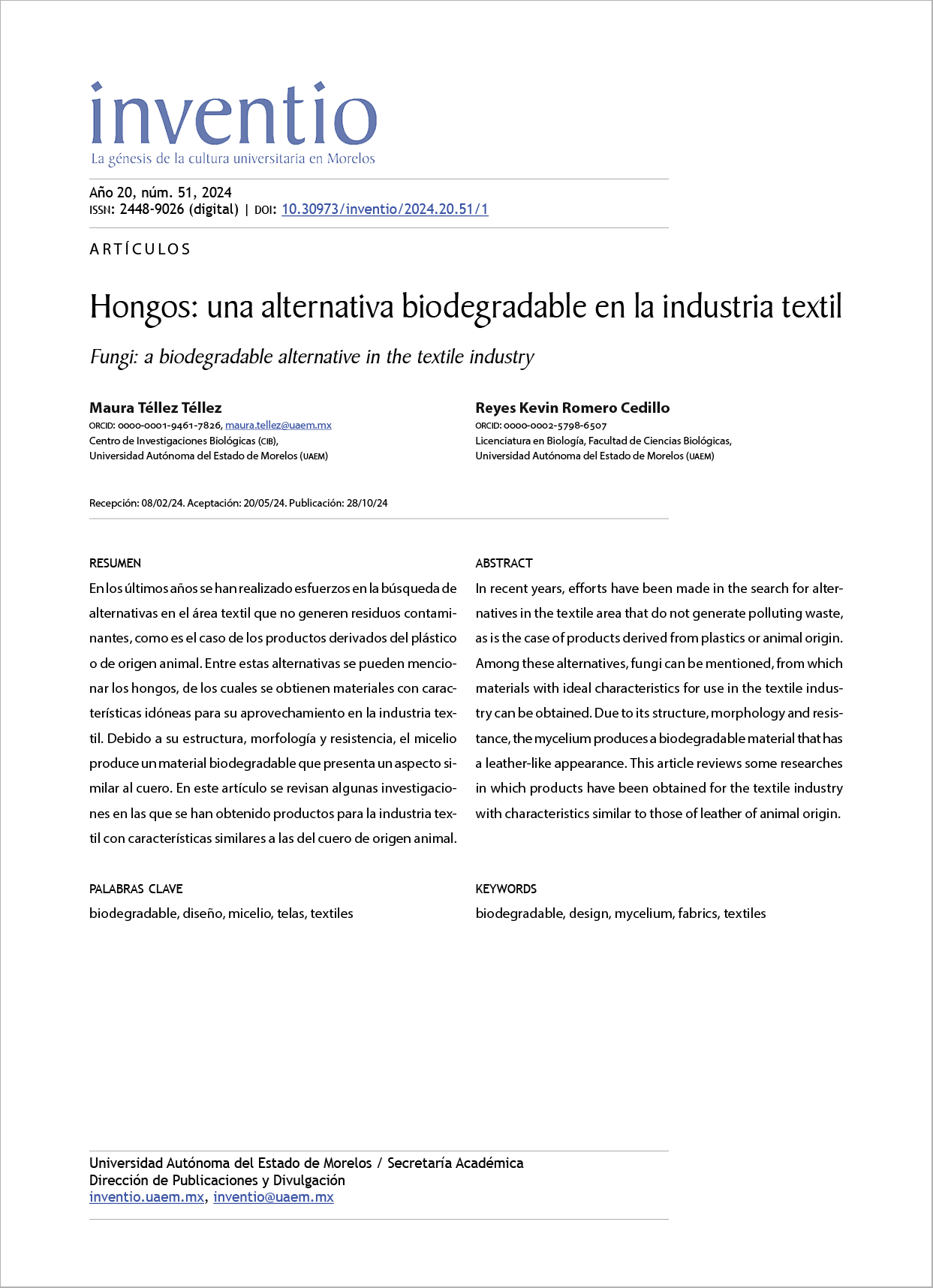
Fungi: a biodegradable alternative in the textile industry
DOI:
https://doi.org/10.30973/inventio/2024.20.51/1Keywords:
biodegradable, design, mycelium, textiles, fabricAbstract
In recent years, efforts have been made in the search for alternatives in the textile area that do not generate polluting waste, as is the case of products derived from plastics or animal origin. Among these alternatives, fungi can be mentioned, from which materials with ideal characteristics for use in the textile industry can be obtained. Due to its structure, morphology and resistance, the mycelium produces a biodegradable material that has a leather-like appearance. This article reviews some researches in which products have been obtained for the textile industry with characteristics similar to those of leather of animal origin.
References
Adidas (15 de abril de 2021). Stan Smith Mylo: recreating an icon made with underground roots of mushrooms. Adidas, sp. https://news.adidas.com/originals/stan-smith-mylo--recreating-an-icon-made-with-underground-roots-of-mushrooms/s/3403a796-7db3-429c-8a3b-6378c2f962b0
Attias, N., Danai, O., Abitbol, T., Tarazi, E., Ezov, N., Pereman, I. y Grobman, Y. J. (2020). Mycelium bio-composites in industrial design and architecture: comparative review and experimental analysis. Journal of Cleaner Production, 246, 119037. https://doi.org/10.1016/j.jclepro.2019. 119037
Biala, E. y Ostermann, M. (2022). Mycostructures—growth-driven fabrication processes for architectural elements from mycelium composites. Architecture, Structures and Construction, 2, 509-519. https://doi.org/10.1007/s44150-022-00073-6
Blackwell, M. (2011). The Fungi: 1, 2, 3 … 5.1 million species? American Journal of Botany, 98(3), 426-438. https://doi.org/10.3732/ajb.1000298
Chase, J., Wenner, N., Ross, P. y Todd, M. (2019). Deacetylation and crosslinking of chitin and chitosan if fungal materials and their composites for tunable properties. US Patent Application No. 16/353,979, 1-5. https://patentimages.storage.googleapis.com/c1/65/36/ec268f30de0fb4/US20190284307A1.pdf
Ecoinventos (12 de abril de 2022). 12 alternativas ecológicas al cuero animal. EcoInventos, sp. https://ecoinventos.com/alternativas-ecologicas-al-cuero-animal/#google_vignette.
Ecovative (2023). Ecovative: molecular mycotechnology. Ecovative, sp. https://ecovativedesign.com
Gandia, A., Brandhof, J. G. van den, Appels, F. V. W. y Jones, M. P. (2021). Flexible fungal materials: shaping the future. Trends in Biotechnology, 39(12), 1321-1331. https://doi.org/10.1016/j.tibtech.2021.03.002
Goyeneche, S. (2018). Cuero natural vs cuero sintético. El Impacto Socioambiental. [Tesis de licenciatura, UP]. https://fido.palermo.edu/servicios_dyc/proyectograduacion/archivos/4726.pdf
Hawksworth, D. L. y Lücking, R. (2017). Fungal Diversity Revisited: 2.2 to 3.8 Million Species. Microbiology spectrum, 5(4). https://doi.org/10.1128/microbiolspec.funk-0052-2016
Kumar, V. y Dwivedi, S. K. (2021). Una revisión sobre técnicas accesibles para la eliminación de cromo hexavalente y níquel divalente de las aguas residuales industriales: investigación reciente y perspectivas futuras. Revista de Producción Más Limpia, 295, 126229. https://doi.org/10.1016/j.jclepro.2021.126229
Life Materials (sf). MuSkin. Life Materials, sp. https://lifematerials.eu/shop/muskin-cruelty-free-and-oil-free-vegan-leatherette/
López Buitrago, N. (2022). Alternativas, usos e impactos ambientales de la moda con la elaboración de prendas de vestir con tejido animal. [Tesis de licenciatura, IUPASCUALBRAVO]. https://repositorio.pascualbravo.edu.co/handle/pascualbravo/1518
Meyer, M., Dietrich, S., Schulz, H. y Mondschein, A. (2021). Comparison of the technical performance of leather, artificial leather, and trendy alternatives. Coatings, 11(2), 226. https://doi.org/10.3390/coatings11020226
Mycoworks (2018). Home. MycoWorks, sp. http://www.mycoworks.com/2018
Mylea (sf). Technical data sheet MyleaTM, the mycelium leather mylea original reinforced. Mylea, sp. https://mycl.bio/storage/app/media/mylea/Mylea%20Technical%20Data%20Sheet.pdf
Nai, C. y Meyer, V. (2016). The beauty and the morbid: fungi as source of inspiration in contemporary art. Fungal Biology and Biotechnology, 3(10), 1-5. https://doi.org/10.1186/s40694-016-0028-4
Zeller, P. y Zocher, D. (2012). Ecovative’s breakthrough biomaterials. Fungi Magazine, 5(1), 51-56. https://www.fungimag.com/spring-2012-articles/LR_Ecovative.pdf
Downloads
Published
Issue
Section
License
Copyright (c) 2024 Maura Téllez Téllez, Reyes Kevin Romero Cedillo

This work is licensed under a Creative Commons Attribution-NonCommercial 4.0 International License.
Esta revista proporciona acceso abierto inmediato a su contenido, con base en el principio de ofrecer al público un acceso libre a las investigaciones para contribuir a un mayor intercambio global de conocimientos. Se distribuye bajo una licencia Creative Commons Reconocimiento-NoComercial 4.0 Internacional License.