The odyssey of rare diseases
DOI:
https://doi.org/10.30973/inventio/2023.19.49/7Keywords:
rare diseases, genetic diagnosis, next generation sequencing, gene therapy, cell therapyAbstract
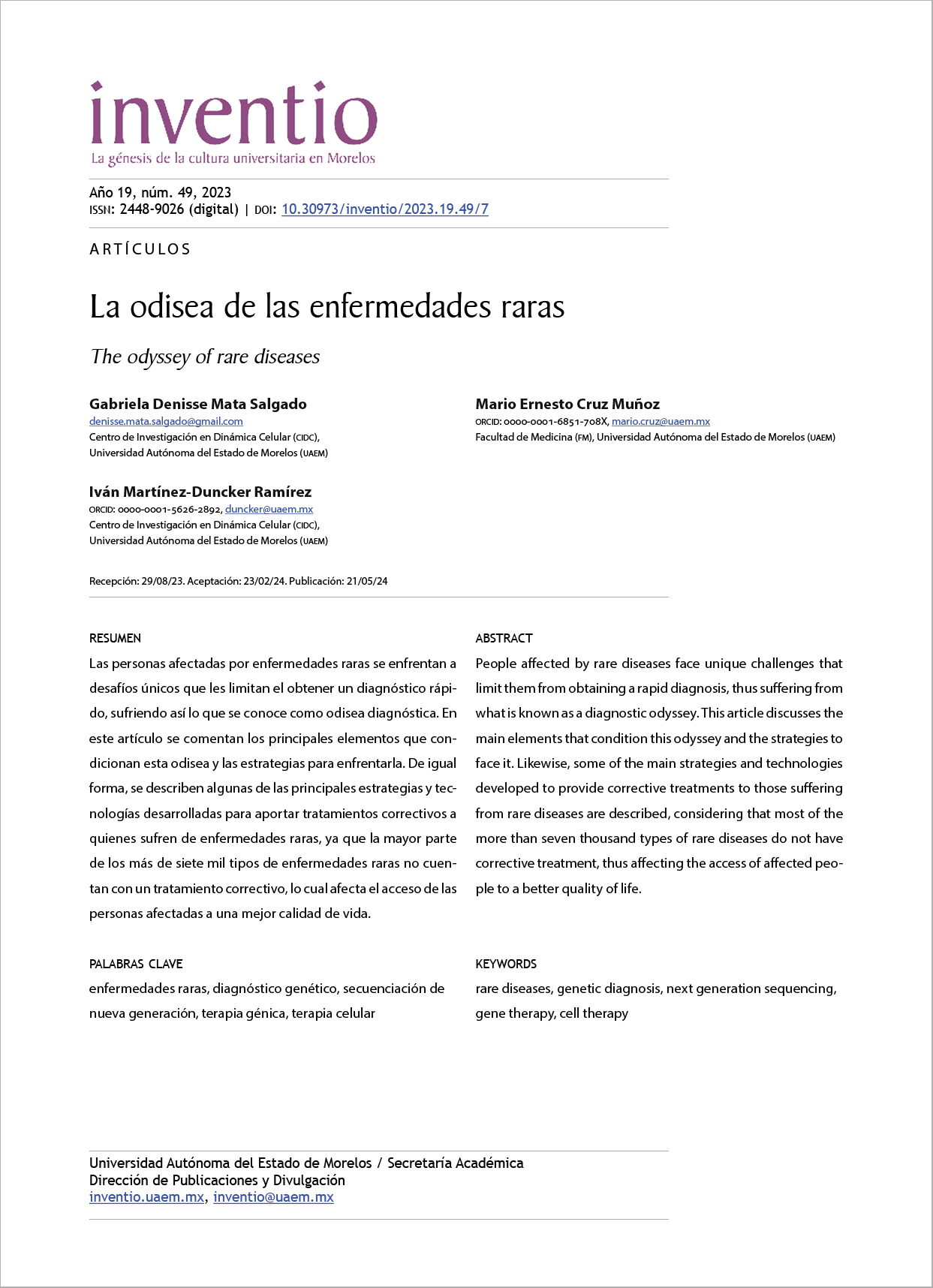
People affected by rare diseases face unique challenges that limit them from obtaining a rapid diagnosis, thus suffering from what is known as a diagnostic odyssey. This article discusses the main elements that condition this odyssey and the strategies to face it. Likewise, some of the main strategies and technologies developed to provide corrective treatments to those suffering from rare diseases are described, considering that most of the more than seven thousand types of rare diseases do not have corrective treatment, thus affecting the access of affected people to a better quality of life.
References
Bavisetty, S., Grody, W. W. y Yazdani, S. (2013). Emergence of pediatric rare diseases: review of present policies and opportunities for improvement. Rare Diseases, 1(1), e23579. https://doi.org/10.4161/rdis.23579
Bauskis, A., Strange, C., Molster, C. y Fisher, C. (2022). The diagnostic odyssey: insights from parents of children living with an undiagnosed condition. Orphanet Journal of Rare Diseases, 17(1), 233. https://ojrd.biomedcentral.com/articles/10.1186/s13023-022-02358-x
Danese, E. y Lippi, G. (2018). Rare diseases: the paradox of an emerging challenge. Annals of Translational Medicine, 6(17). https://doi.org/10.21037%2Fatm.2018.09.04
Day, J. W., Howell, K., Place, A., Long, K., Rossello, J., Kertesz, N. y Nomikos, G. (2022). Advances and limitations for the treatment of spinal muscular atrophy. BMC Pediatrics, 22(1), 632. https://doi.org/10.1186/s12887-022-03671-x
Gonçalves, G. A. R. y Paiva, R. D. M. A. (2017). Gene therapy: advances, challenges and perspectives. Einstein (Sao Paulo), 15, 369-375. https://doi.org/10.1590%2FS1679-45082017RB4024
Germain, D. P., Elliott, P. M., Falissard, B., Fomin, V. V., Hilz, M. J., Jovanovic, A., Kantola, I., Linhart, A., Mignani, R., Namdar, M., Nowak, A., Oliveira, J.-P., Pieroni, M., Viana-Baptista, M., Wanner, C., y Spada, M. (2019). The effect of enzyme replacement therapy on clinical outcomes in male patients with Fabry disease: a systematic literature review by a European panel of experts. Molecular Genetics and Metabolism Reports, 19, 100454. https://doi.org/10.1016/j.ymgmr.2019.100454
Haendel, M., Vasilevsky, N., Unni, D., Bologa, C., Harris, N., Rehm, H., Hamosh, A., Baynam, G., Groza, T., McMurry, J., Dawkins, H., Rath, A., Thaxton, C., Bocci, G., Joachimiak, Marcin P., Köhler, S., Robinson, P. N., Mungall, C. y Oprea, T. I. (2020). How many rare diseases are there? Nature Reviews Drug Discovery, 19(2), 77-78. https://doi.org/10.1038/d41573-019-00180-y
Hayward, J. y Chitty, L. S. (2018). Beyond screening for chromosomal abnormalities: advances in non-invasive diagnosis of single gene disorders and fetal exome sequencing. Seminars in Fetal and Neonatal Medicine, 23(2), 94-101. https://doi.org/10.1016/j.siny.2017.12.002
Iyer, S., Sam, F. S., DiPrimio, N., Preston, G., Verheijen, J., Murthy, K., Parton, Z., Tsang, H., Lao, J., Morava, E. y Perlstein, E. O. (2019). Repurposing the aldose reductase inhibitor and diabetic neuropathy drug epalrestat for the congenital disorder of glycosylation PMM2-CDG. Disease Models & Mechanisms, 12(11), dmm040584. https://doi.org/10.1242/dmm.040584
Jonker, A. H., O’Connor, D., Cavaller-Bellaubi, M., Fetro, C., Gogou, M., ’T Hoen, P. A. C., Kort, M., Stone, H., Valentine, N. y Pasmooij, A. M. G. (2024). Drug repurposing for rare: progress and opportunities for the rare disease community. Frontiers in Medicine, 11, 1352803. https://doi.org/10.3389/fmed.2024.1352803
Marimpietri, D. y Zuccari, G. (2023). Development of medicines for rare pediatric diseases. Pharmaceuticals, 16(4), 513. https://doi.org/10.3390%2Fph16040513
Marwaha, S., Knowles, J. W. y Ashley, E. A. (2022). A guide for the diagnosis of rare and undiagnosed disease: beyond the exome. Genome Medicine, 14(1), 23. https://doi.org/10.1186/s13073-022-01026-w
Ogbonmide, T., Rathore, R., Rangrej, S. B., Hutchinson, S., Lewis, M., Ojilere, S., Carvalho, V. y Kelly, I. (2023). Gene therapy for spinal muscular atrophy (SMA): a review of current challenges and safety considerations for onasemnogene abeparvovec (Zolgensma). Cureus, 15(3), sp. https://doi.org/10.7759/cureus.36197
Pletcher, B. A., Toriello, H. V., Noblin, S. J., Seaver, L. H., Driscoll, D. A., Bennett, R. L. y Gross, S. J. (2007). Indications for genetic referral: a guide for healthcare providers. Genetics in Medicine, 9(6), 385-389. https://doi.org/10.1097/gim.0b013e318064e70c
Roth, T. L. y Marson, A. (2021). Genetic disease and therapy. Annual Review of Pathology: Mechanisms of Disease, 16, 145-166. https://doi.org/10.1146/annurev-pathmechdis-012419-032626
Sivandzade, F. y Cucullo, L. (2021). Regenerative stem cell therapy for neurodegenerative diseases: an overview. International Journal of Molecular Sciences, 22(4), 2153. https://doi.org/10.3390/ijms22042153
The Lancet Global Health (2024). The landscape for rare diseases in 2024. The Lancet Global Health, 12(3), e341. https://doi.org/10.1016/s2214-109x(24)00056-1
Uddin, F., Rudin, C. M. y Sen, T. (2020). CRISPR gene therapy: applications, limitations, and implications for the future. Frontiers in Oncology, 10, 1387. https://doi.org/10.3389/fonc.2020.01387
Sher, S., Shamberg, M. (prods.) y Vaughan, T. (dir.) (2010). Medidas extraordinarias. Sony Pictures. 106 min.
Wojtara, M., Rana, E., Rahman, T., Khanna, P. y Singh, H. (2023). Artificial intelligence in rare disease diagnosis and treatment. Clinical and Translational Science, 16(11), 2106-2111. https://doi.org/10.1111/cts.13619
Downloads
Published
Issue
Section
License
Copyright (c) 2005 Gabriela Denisse Mata Salgado, Iván Martínez-Duncker Ramírez, Mario Ernesto Cruz Muñoz

This work is licensed under a Creative Commons Attribution-NonCommercial 4.0 International License.
Esta revista proporciona acceso abierto inmediato a su contenido, con base en el principio de ofrecer al público un acceso libre a las investigaciones para contribuir a un mayor intercambio global de conocimientos. Se distribuye bajo una licencia Creative Commons Reconocimiento-NoComercial 4.0 Internacional License.