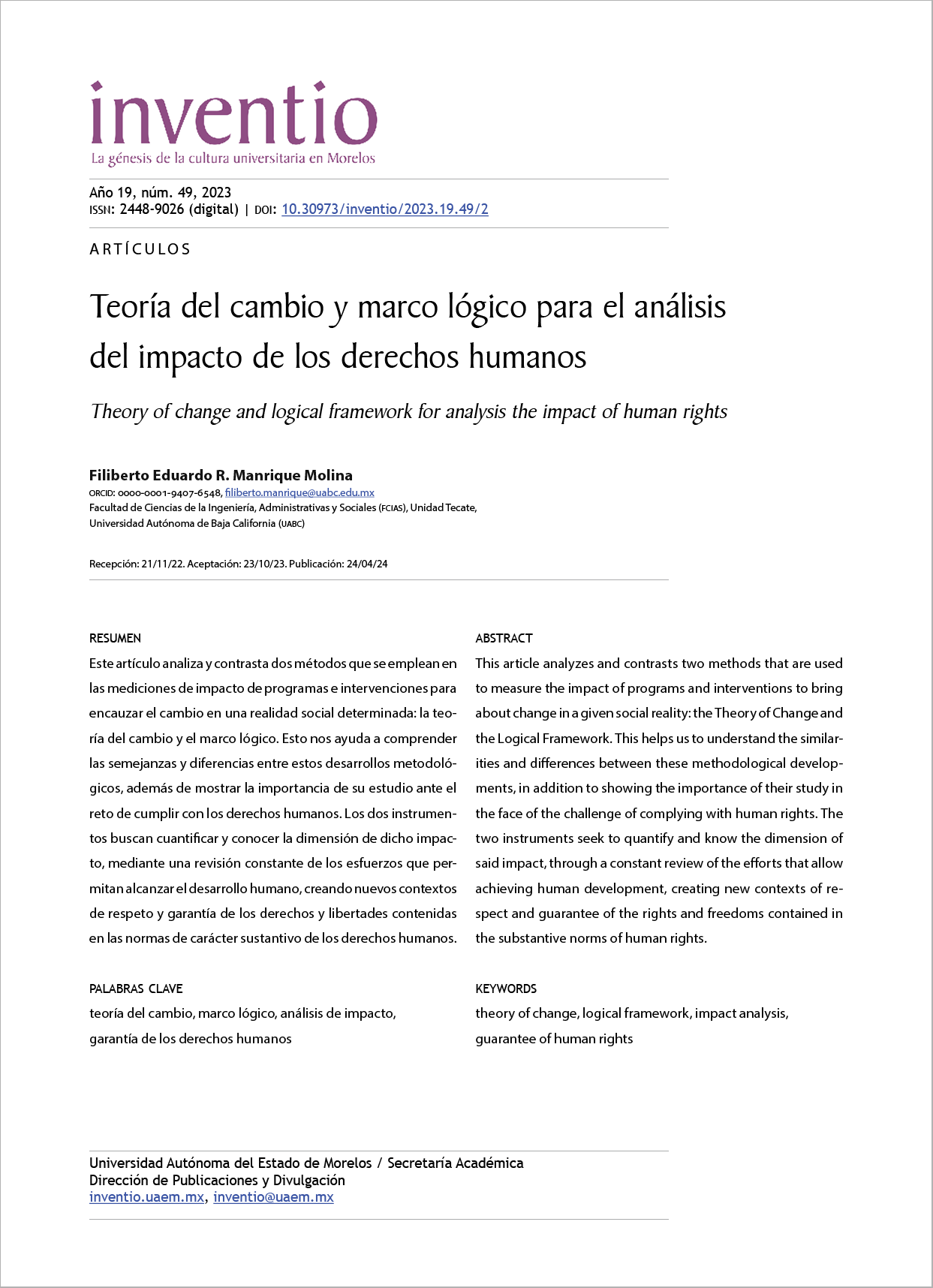
Theory of change and logical framework for analysis the impact of human rights
DOI:
https://doi.org/10.30973/inventio/2023.19.49/2Keywords:
theory of change, logical framework, impact analysis, guarantee of human rightsAbstract
This article analyzes and contrasts two methods that are used to measure the impact of programs and interventions to bring about change in a given social reality: the Theory of Change and the Logical Framework. This helps us to understand the similarities and differences between these methodological developments, in addition to showing the importance of their study in the face of the challenge of complying with human rights. The two instruments seek to quantify and know the dimension of said impact, through a constant review of the efforts that allow achieving human development, creating new contexts of respect and guarantee of the rights and freedoms contained in the substantive norms of human rights.
References
Anderson, A. A. (2017). The community builder’s approach to Theory of Change. A practical Guide to theory development. The Aspen Institute. https://www.theoryofchange.org/pdf/TOC_fac_guide.pdf
Cassetti, V. y Paredes-Carbonell, J. (2020). La teoría del cambio: una herramienta para la planificación y la evaluación participativa en salud comunitaria. Gaceta Sanitaria, 34(3), 305-307. https://dx.doi.org/10.1016/j.gaceta.2019.06.002
Crespo A., M. A. (2009). Guía de diseño de proyectos sociales comunitarios bajo el enfoque del marco lógico (conceptos esenciales y aplicaciones). mimeo. https://ilcrobertschuman.files.wordpress.com/2013/07/libro-crespo.pdf
De Silva, M., Lee, L., Asher, L. y Ryan, G. (2014). Using theory of change in the development, implementation and evaluation of complex health interventions. A practical guide. Mental Health Innovation Network. https://content.changeroo.com/wp-content/uploads/Academy/2017/07/MHIN-ToC-guidelines_May_2015.pdf
Gosling, L. y Edwards, M. (2006). Toolkits: a practical guide to planning, monitoring, evaluation and impact assessment. Save the Children Fund. https://resourcecentre.savethechildren.net/document/practical-guide-assessment-monitoring-review-and-evaluation-2nd-edition/
Gready, P. y Robins, S. (2020). Transitional justice and theories of change: towards evaluation as understanding. The International Journal of Transitional Justice, 14(2), 280-299. https://doi.org/10.1093/ijtj/ijaa008
Harries, E., Hodgson, L. y Noble, J. (2014). Creating your theory of change. NPC’s practical guide. NPC. https://www.thinknpc.org/wp-content/uploads/2018/07/Creating-your-theory-of-change1.pdf
Huertas Díaz, O. (2019). Política criminal sistémica. Origen rizomático y contribuciones para su reflexión. Ibáñez.
Huertas Díaz, O., R. Manrique Molina, F. E. y Hernández Ramírez, M. Y. (2022). Metodología para medir y evaluar el cumplimiento e impacto de sentencias de la Corte Interamericana de Derechos Humanos. IUSTA. Derecho, Investigación, Conflicto, Prácticas Jurídicas, (56), 189-213. https://doi.org/10.15332/25005286.7764
Instituto Nacional de las Mujeres (2014). Hacia una metodología de marco lógico con perspectiva de género. INMUJERES/ONU Mujeres. https://mexico.unwomen.org/sites/default/files/Field%20Office%20Mexico/Documentos/Publicaciones/2014/Metodolog%C3%ADa%20de%20Marco%20Te%C3%B3rico.pdf
Ortegón, E., Pacheco, J. A. y Prieto, A. (2015). Metodología del marco lógico para la planificación, el seguimiento y la evaluación de proyectos y programas. CEPAL. https://repositorio.cepal.org/server/api/core/bitstreams/2d86ecfb-f922-49d3-a919-e4fd4d463bd7/content
R. Manrique Molina, F. E. (2021). Ius anticorruptionis commune latinoamericanum desde el enfoque basado en los derechos humanos. UNIJUS.
Rogers, P. (2014). La teoría del cambio. Síntesis metodológicas. Sinopsis de la evaluación de impacto n.° 2. UNICEF. https://www.entwicklung.at/fileadmin/user_upload/Dokumente/Evaluierung/Theory_of_Change/UNICEF_Theory_of_change.pdf
Serrat, O. (2017). Knowledge solutions: tools, methods, and approaches to drive organizational performance. Springer. https://doi.org/10.1007/978-981-10-0983-9
United Nations Development Group (2017). Theory of change. UNSDG.
Weiss, C. H. (1998). Evaluation, methods for studying programs and policies. Prentice-Hall.
Downloads
Published
Issue
Section
License
Copyright (c) 2005 Filiberto Eduardo R. Manrique Molina

This work is licensed under a Creative Commons Attribution-NonCommercial 4.0 International License.
Esta revista proporciona acceso abierto inmediato a su contenido, con base en el principio de ofrecer al público un acceso libre a las investigaciones para contribuir a un mayor intercambio global de conocimientos. Se distribuye bajo una licencia Creative Commons Reconocimiento-NoComercial 4.0 Internacional License.