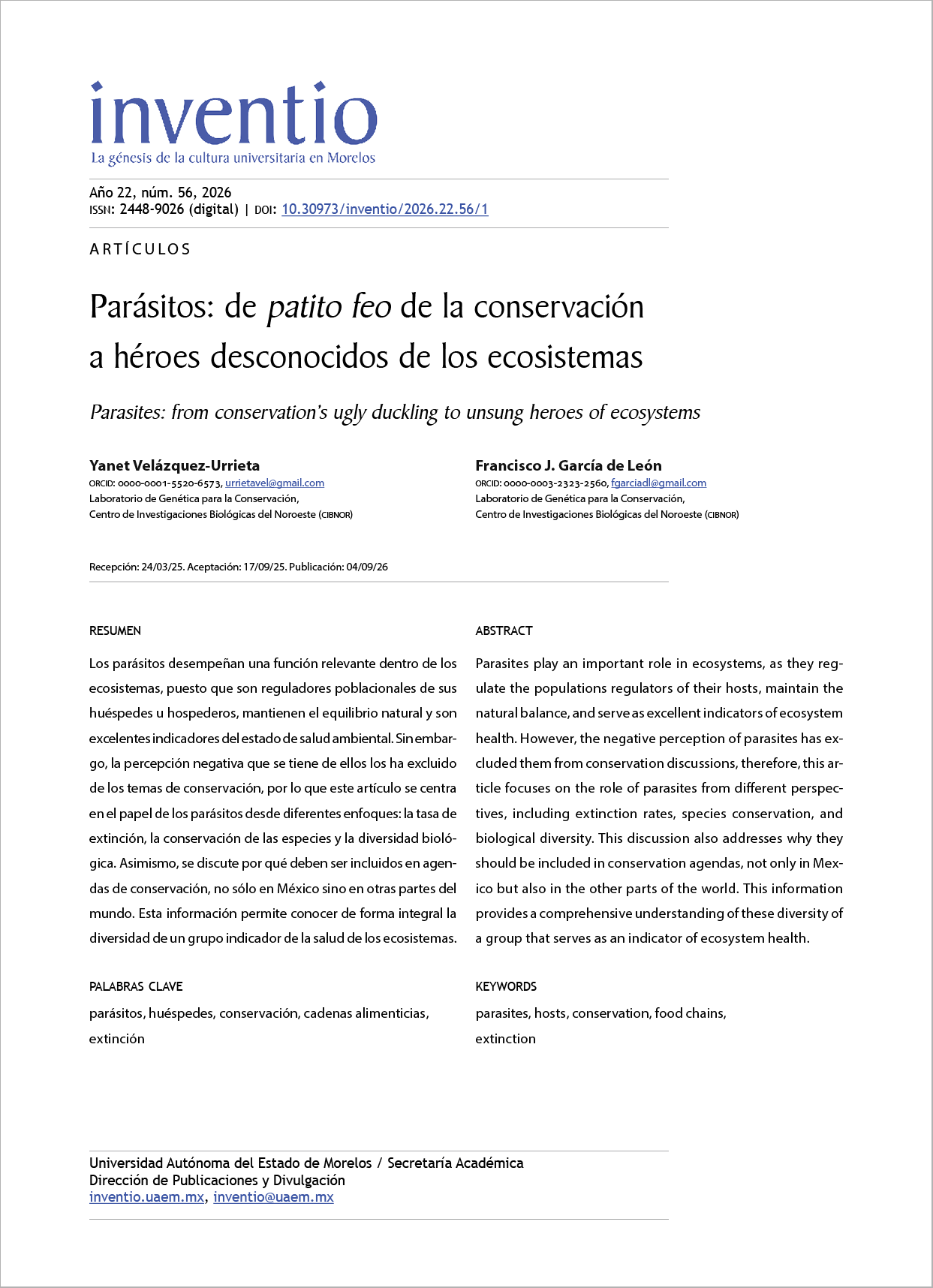
Parasites: from conservation’s ugly duckling to unsung heroes of ecosystems
DOI:
https://doi.org/10.30973/inventio/2026.22.56/1Keywords:
parasites, host, food web, conservation, extinción, extinctionAbstract
Parasites play an important role in ecosystems, as they regulate the populations regulators of their hosts, maintain the natural balance, and serve as excellent indicators of ecosystem health. However, the negative perception of parasites has excluded them from conservation discussions, therefore, this article focuses on the role of parasites from different perspectives, including extinction rates, species conservation, and biological diversity. This discussion also addresses why they should be included in conservation agendas, not only in Mexico but also in the other parts of the world. This information provides a comprehensive understanding of these diversity of a group that serves as an indicator of ecosystem health.
References
Brooks, D. R., León-Regagnon, V. y Pérez-Ponce de León, G. (2001). Los parásitos y la biodiversidad. En H. M. Hernández, A. N. García Aldrete, N. Álvarez y M. Ulloa (comps.), Enfoques contemporáneos para el estudio de la biodiversidad (pp. 245-288). UNAM/FCE. https://books.google.com.mx/books?id=5O1jpX-NoK8C&printsec=frontcover&source=gbs_ge_summary_r&cad=0#v=onepage&q&f=false
Hudson, P. J., Dobson, A. P. y Lafferty, K. D. (2006). Is a healthy ecosystem one that is rich in parasites? Trend in Ecology and Evolution, 21(7), 381-385. https://doi.org/10.1016/j.tree.2006.04.007
Johnson, P. T. J., Dobson, A., Lafferty, K. D., Marcogliese, D. J., Memmott, J., Orlofske, S. A., Poulin, R. y Thieltges, D. W. (2010). When parasites become prey: ecological and epidemiological significance of eating parasites. Trends in Ecology & Evolution, 25(6), 362-371. https://doi.org/10.1016/j.tree.2010.01.005
Manter, H. W. (1966). Parasites of fishes as biological indicators of recent and ancient conditions. En J. E. McCauley (ed.), Host-parasite relationships (pp. 59-71). Oregon State University Press.
McLaughlin, J. P., Morton, D. N. y Lafferty, K. D. (2020). Parasites in marine food webs. En D. C. Behringer, B. R. Silliman y K. D. Lafferty (eds.), Marine disease ecology (pp. 45-60). Oxford University Press. http://ebooks.tau.edu.ng:8083/read/3726/pdf
Schmid-Hempel, P. (2009). Immune defense, parasite evasion strategies and their relevance for “macroscopic phenomena” such as virulence. The Royal Society, 364(1513), 85-98. https://doi.org/10.1098/rstb.2008.0157
Secretaría de Medio Ambiente y Recursos Naturales (30 de diciembre de 2010). Norma Oficial Mexicana NOM-059-SEMARNAT-2010, Protección ambiental-Especies nativas de México de flora y fauna silvestres-categorías de riesgo y especificaciones para su inclusión, exclusión o cambio-lista de especies en riesgo. DOF, DCLXXXVII(23), Segunda Sección, ed. mat., 1-77. https://www.profepa.gob.mx/innovaportal/file/3552/1/nom-059-semarnat-2010__30-dic-2010.pdf
Shaw, R. E., Farquharson, K. A., Bruford, M. W., Coates, D. J., Elliott, C. P., Mergeay, J., Ottewell, K. M., Segelbacher, G., Hoban, S., Hvilsom, C., Pérez-Espona, S., Ruņģis, D., Aravanopoulos, F., Bertola, L., Cotrim, H., Cox, K., Cubric-Curik, V., Ekblom, R., Godoy, J. A., … y Grueber, C. E. (2025). Global meta-analysis shows action is needed to halt genetic diversity loss. Nature, 638(8051), 704-710. https://doi.org/10.1038/s41586-024-08458-x
Thomas, F., Poulin, R. y Brodeur, J. (2010). Host manipulation by parasites: a multidimensional phenomenon. Oikos, 119(8), 1217-1223. https://doi.org/10.1111/j.1600-0706.2009.18077.x
Velázquez Urrieta, M. Y. (2022). Caracterización del ciclo de vida de trematodos parásitos de anfibios en la selva tropical de Los Tuxtlas, a través de datos morfológicos, y secuencias de genes mitocondriales y nucleares. [Tesis de doctorado, UNAM]. https://tesiunamdocumentos.dgb.unam.mx/ptd2022/agosto/0828748/Index.html
Windsor, D. A. (1997). Equal rights for parasites. Perspectives in Biology and Medicine, 40(2), 222-229. https://doi.org/10.1353/pbm.1997.0011
Downloads
Published
Issue
Section
License
Copyright (c) 2026 Yanet Velázquez Urrieta, Francisco García de León

This work is licensed under a Creative Commons Attribution-NonCommercial 4.0 International License.
Esta revista proporciona acceso abierto inmediato a su contenido, con base en el principio de ofrecer al público un acceso libre a las investigaciones para contribuir a un mayor intercambio global de conocimientos. Se distribuye bajo una licencia Creative Commons Reconocimiento-NoComercial 4.0 Internacional License.