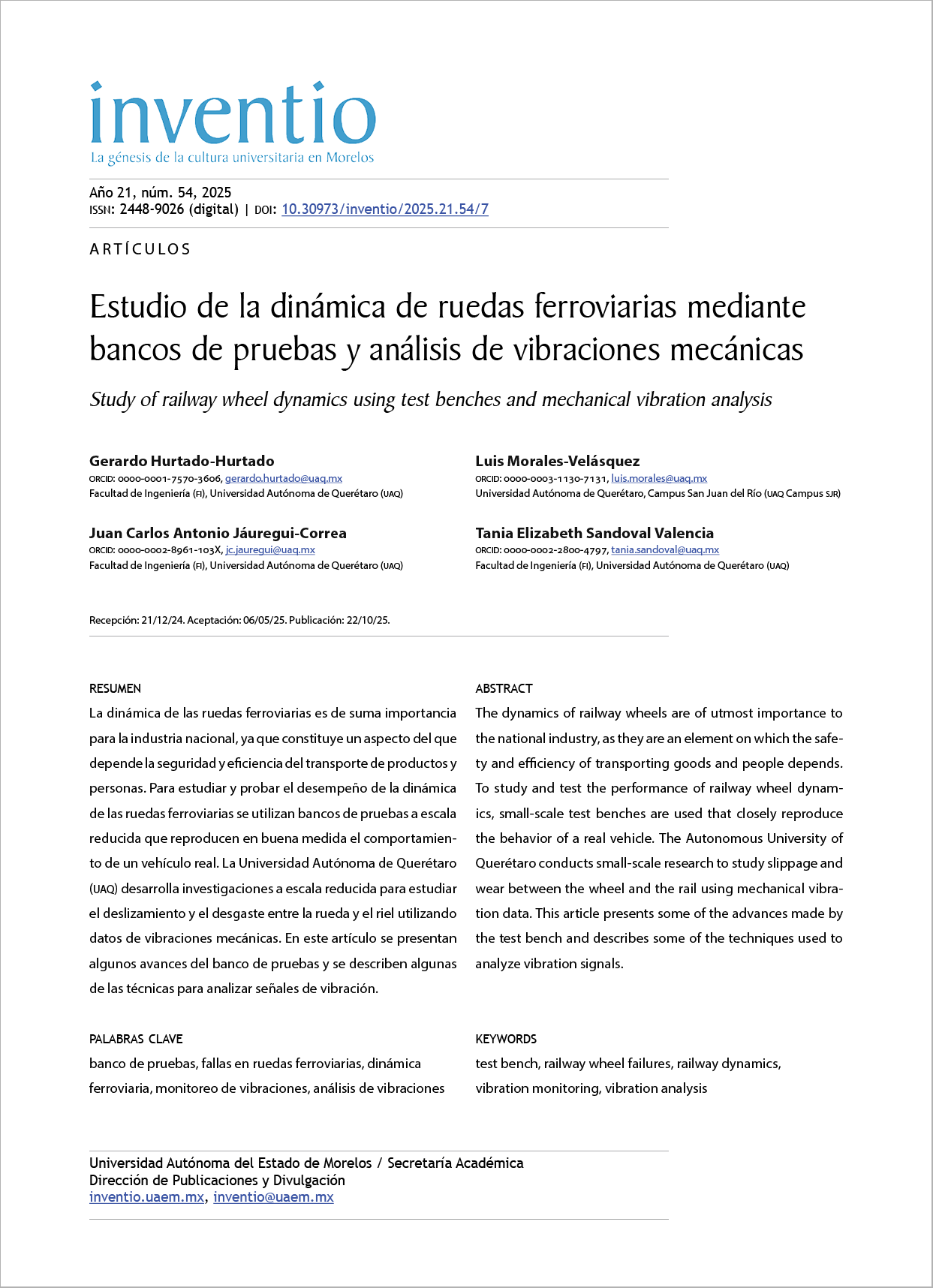
Study of railway wheel dynamics using test benches and mechanical vibration analysis
DOI:
https://doi.org/10.30973/inventio/2025.21.54/7Keywords:
test bench, railway wheel failures, railway dinamics, vibration monitoring, vibration analysisAbstract
The dynamics of railway wheels are of utmost importance to the national industry, as they are an element on which the safety and efficiency of transporting goods and people depends. To study and test the performance of railway wheel dynamics, small-scale test benches are used that closely reproduce the behavior of a real vehicle. The Autonomous University of Querétaro conducts small-scale research to study slippage and wear between the wheel and the rail using mechanical vibration data. This article presents some of the advances made by the test bench and describes some of the techniques used to analyze vibration signals.
References
Arias-Cuevas, O., Z. Li, Z. y R. Lewis, R. (2011). A laboratory investigation on the influence of the particle size and slip during sanding on the adhesion and wear in the wheel-rail contact. Wear, 271(1-2), 14-24, 2011. https://doi.org/10.1016/j.wear.2010.10.050
Bruno, L., Horvat, M. y Raffaele, L. (2018). Windblown sand along railway infrastructures: A review of challenges and mitigation measures. Journal of Wind Engineering and Industrial Aerodynamics, 177, 340-365. https://www.sciencedirect.com/science/article/pii/S0167610518301442
Eadie, D. T., Elvidge, D., Oldknow, K., Stock, R., Pointner, P., Kalousek, J. y Klauser, P. (2008). The effects of top of rail friction modifier on wear and rolling contact fatigue: Full-scale rail-wheel test rig evaluation, analysis and modelling. Wear, 265(9-10), 1222-1230. https://doi.org/10.1016/j.wear.2008.02.029
Gallardo-Hernández, E. A. y Lewis, R. (2008). Twin disc assessment of wheel/rail adhesion. Wear, 265(9-10), 1309-1316. https://doi.org/10.1016/j.wear.2008.03.020
Hurtado Hurtado, G. H. (2023). Respuesta dinámica de los vehículos ferroviarios derivada del coeficiente de fricción rueda-riel. [Tesis de doctorado, UAQ]. https://ri-ng.uaq.mx/handle/123456789/8953
Hurtado-Hurtado, G., Morales-Velázquez, L., Otremba, F. y Jáuregui-Correa, J. C. (2023). Railcar dynamic response during braking maneuvers based on frequency analysis. Applied Sciences, 13(7), 4132. https://doi.org/10.3390/app13074132
Iwnicki, S. (ed.) (2006). Handbook of railway vehicle dynamics. CRC press. http://www.iqytechnicalcollege.com/Handbook%20of%20Railway%20Vehicle%20Dynamics.pdf
Jung, H., Münker, T., Kampmann, G., Rave, K., Fritzen, C.-P. y Nelles, O. (2016, July). A novel full-scale roller rig test bench for SHM concepts of railway vehicles [ponencia]. Presentada en el XIII European Workshop On Structural Health Monitoring, 5 al 8 de julio, Bilbao (pp. 5-8). https://www.ndt.net/events/EWSHM2016/app/content/Paper/331_Jung.pdf
Kabo, E., Ekberg, A., Torstensson, P. T. y Vernersson, T. (2010). Rolling contact fatigue prediction for rails and comparisons with test rig results. Journal of Rail and Rapid Transit, 224(4), 303-317. https://doi.org/10.1243/09544097JRRT343
Naeimi, M., Li, Z. y Dollevoet, R. (2014). Scaling strategy of a new experimental rig for wheel-rail contact. International Journal of Civil and Environmental Engineering, 8(12), 19901787-19971794. https://repository.tudelft.nl/record/uuid:6bb36d62-07ed-49f5-9176-c9c5d8e2dfa1
Wu, Y., Wang, J., Liu, M., Jin, X., Hu, X., Xiao, X. y Wen, Z. (2022). Polygonal wear mechanism of high-speed wheels based on full-size wheel-rail roller test rig. Wear, 494, 204234. https://doi.org/10.1016/j.wear.2021.204234
Yoshino, H., Hosoya, T., Yabuno, H., Lin, S. y Suda, Y. (2015). Theoretical and experimental analyses on stabilization of hunting motion by utilizing the traction motor as a passive gyroscopic damper. Journal of Rail and Rapid Transit, 229(4), 395-401. https://doi.org/10.1177/0954409715569860
Downloads
Published
Issue
Section
License
Copyright (c) 2025 Gerardo Hurtado Hurtado, Juan Carlos Antonio Jáuregui Correa, Luis Morales Velásquez, Tania Elizabeth Sandoval Valencia

This work is licensed under a Creative Commons Attribution-NonCommercial 4.0 International License.
Esta revista proporciona acceso abierto inmediato a su contenido, con base en el principio de ofrecer al público un acceso libre a las investigaciones para contribuir a un mayor intercambio global de conocimientos. Se distribuye bajo una licencia Creative Commons Reconocimiento-NoComercial 4.0 Internacional License.