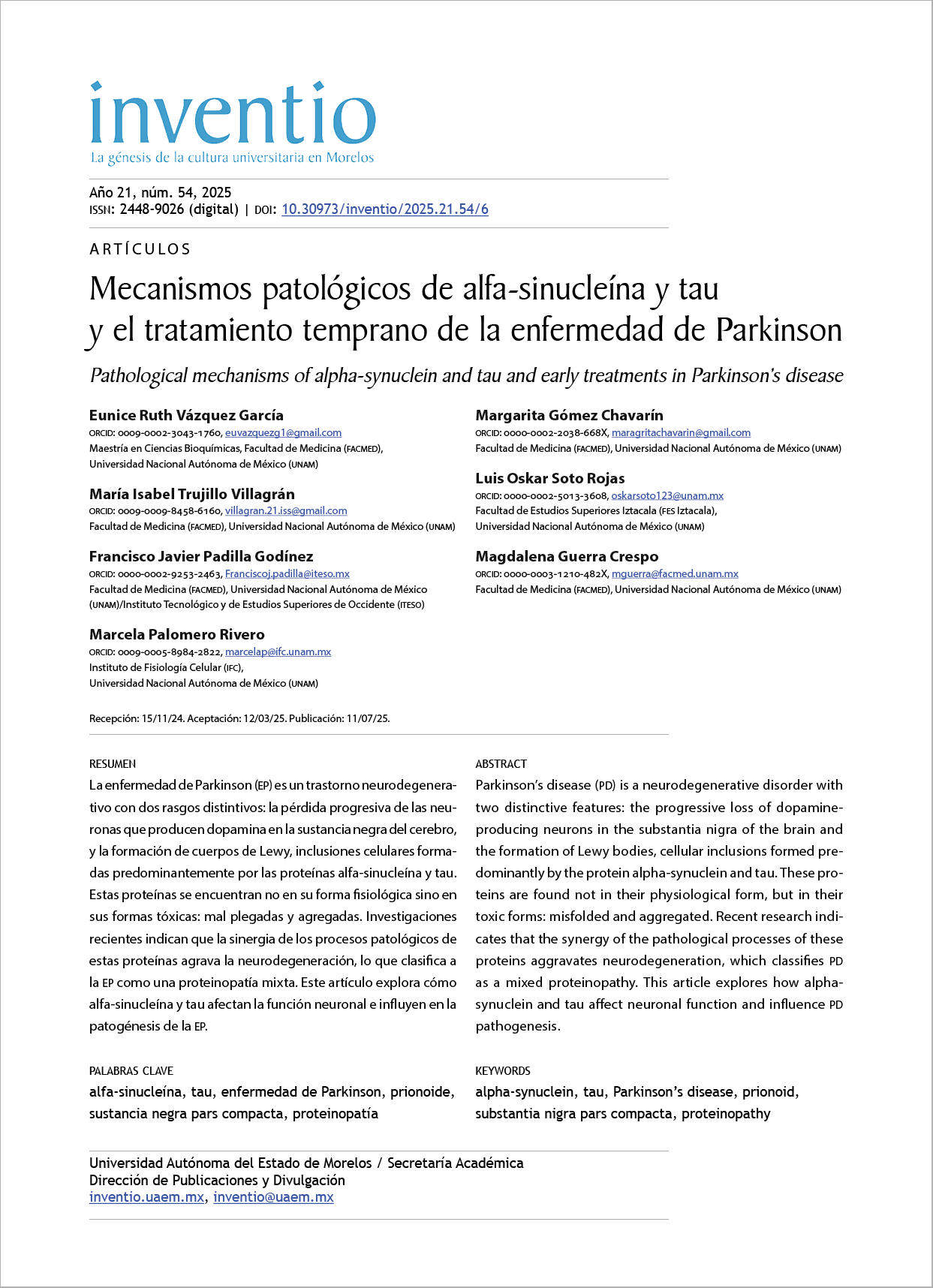
Pathological mechanisms of alpha-synuclein and tau and early treatments in Parkinson’s disease
DOI:
https://doi.org/10.30973/inventio/2025.21.54/6%20Keywords:
alpha-synuclein, tau, Parkinson's disease, prionoid, substantia migra pars compacta, proteinopathyAbstract
Parkinson's disease (pd) is a neurodegenerative disorder with two distinctive features: the progressive loss of dopamine-producing neurons in the substantia nigra of the brain and the formation of Lewy bodies, cellular inclusions formed predominantly by the protein alpha-synuclein and tau. These proteins are found not in their physiological form, but in their toxic forms: misfolded and aggregated. Recent research indicates that the synergy of the pathological processes of these proteins aggravates neurodegeneration, which classifies pd as a mixed proteinopathy. This article explores how alpha-synuclein and tau affect neuronal function and influence pd pathogenesis.
References
Bernal-Conde, L. D., Peña-Martínez, V., Morato-Torres, C. A., Ramos-Acevedo, R., Arias-Carrión, Ó., Padilla-Godínez, F. J., Delgado-González, A., Palomero-Rivero, M., Collazo-Navarrete, O., Soto-Rojas, L. O., Gómez-Chavarrín, M., Schüle, B. y Guerra-Crespo, M. (2024). Alpha-synuclein gene alterations modulate tyrosine hydroxylase in human iPSC-derived neurons in a Parkinson’s disease animal model. Life, 14(6), 1-22. https://doi.org/10.3390/life14060728
Brás, I. C. y Outeiro, T. F. (2021). Alpha-synuclein: mechanisms of release and pathology progression in synucleinopathies. Cells, 10(2), 1-19. https://doi.org/10.3390/cells10020375
Calabresi, P., Di Lazzaro, G., Marino, G., Campanelli, F. y Ghiglieri, V. (2023). Advances in understanding the function of alpha-synuclein: implications for Parkinson’s disease. Brain, 146(9), 3587-3597. https://doi.org/10.1093/brain/awad150
Duquette, A., Pernègre, C., Veilleux Carpentier, A. y Leclerc, N. (2021). Similarities and differences in the pattern of tau hyperphosphorylation in physiological and pathological conditions: impacts on the elaboration of therapies to prevent tau pathology. Frontiers in Neurology, 11, 1-17. https://doi.org/10.3389/fneur.2020.607680
Ganguly, G., Chakrabarti, S., Chatterjee, U. y Saso, L. (2017). Proteinopathy, oxidative stress and mitochondrial dysfunction: cross talk in Alzheimer’s disease and Parkinson’s disease. Drug Design Development and Therapy, 11, 797-810. https://doi.org/10.2147/dddt.s130514
Hadi, F., Akrami, H., Totonchi, M., Barzegar, A., Massood Nabavi, S. y Shahpasand, K. (2020). α‐synuclein abnormalities trigger focal tau pathology, spreading to various brain areas in Parkinson disease. Journal of Neurochemistry, 157(3), 727-751. https://doi.org/10.1111/jnc.15257
Kitada, T., Ardah, M. T. y Emdadul Haque, M. (2023). History of Parkinson’s disease-associated gene, Parkin: research over a quarter century in quest of finding the physiological substrate. International Journal of Molecular Sciences, 24(23), 1-15. https://doi.org/10.3390/ijms242316734
Krawczuk, D., Groblewska, M., Mroczko, J., Winkel, I. y Mroczko, B. (2024). The role of α-synuclein in etiology of neurodegenerative diseases. International Journal of Molecular Sciences, 25(17), 1-23. https://doi.org/10.3390/ijms25179197
Morris, H. R., Spillantini, M. G., Sue, C. M. y Williams-Gray, C. H. (2024). The pathogenesis of Parkinson’s disease. The Lancet, 403(10423), 293-304. https://doi.org/10.1016/s0140-6736(23)01478-2
Nachman, E. y Verstreken, P. (2021). Synaptic proteostasis in Parkinson’s disease. Current Opinion in Neurobiology, 72, 72-79. https://doi.org/10.1016/j.conb.2021.09.001
Noble, W., Hanger, D. P., Miller, C. C. J. y Lovestone, S. (2013). The importance of tau phosphorylation for neurodegenerative diseases. Frontiers in Neurology, 4, 1-11. https://doi.org/10.3389/fneur.2013.00083
Padilla-Godínez, F. J., Martínez-Becerril, H. A. y Guerra Crespo, M. (2023). ¿Qué hay de nuevo en la búsqueda para tratar la enfermedad de Parkinson? Revista Digital Universitaria, 24(4), 1-9. https://doi.org/10.22201/cuaieed.16076079e.2023.24.4.12
Paterno, G., Bell, B. M., Gorion, K.-M. M., Prokop, S. y Giasson, B. I. (2022). Reassessment of neuronal tau distribution in adult human brain and implications for tau pathobiology. Acta Neuropathologica Communications, 10, 1-14. https://doi.org/10.1186/s40478-022-01394-9
Poewe, W., Seppi, K., Tanner, C. M., Halliday, G. M., Brundin, P., Volkmann, J., Schrag, A. y Lang, A. E. (2017). Parkinson disease. Nature Reviews Disease Primers, 3(1), 1-21. https://doi.org/10.1038/nrdp.2017.13
Sandoval, I. M., Marmion, D. J., Meyers, K. T. y Manfredsson, F. P. (2021). Gene therapy to modulate alpha-synuclein in synucleinopathies. Journal of Parkinson’s Disease, 11(s2), s189-s197. https://doi.org/10.3233/jpd-212679
Shahnawaz, M., Mukherjee, A., Pritzkow, S., Méndez, N., Rabadia, P., Liu, X., Hu, B., Schmeichel, A., Singer, W., Wu, G., Tsai, A.-L., Shirani, H., Nilsson, K. P. R., Low, P. A. y Soto, C. (2020). Discriminating α-synuclein strains in Parkinson’s disease and multiple system atrophy. Nature, 578, 273-277. https://doi.org/10.1038/s41586-020-1984-7
Soto-Rojas, L. O., Martínez-Dávila, I. A., Luna-Herrera, C., Gutiérrez-Castillo, M. E., López-Salas, F. E., Gatica-García, B., Soto-Rodríguez, G., Bringas Tobón, M. E., Flores, G., Padilla-Viveros, A., Bañuelos, C., Blanco-Álvarez, V. M., Dávila-Ayala, J., Reyes-Corona, D., Garcés-Ramírez, L., Hidalgo-Alegría, O., De La Cruz-López, F. y Martínez-Fong, D. (2020). Unilateral intranigral administration of β-sitosterol β-D-glucoside triggers pathological α-synuclein spreading and bilateral nigrostriatal dopaminergic neurodegeneration in the rat. Acta Neuropathologica Communications, 8, 1-26. https://doi.org/10.1186/s40478-020-00933-6
Tapia-Rojas, C., Cabezas-Opazo, F., Deaton, C. A., Vergara, E. H., Johnson, G. V. W. y Quintanilla, R. A. (2019). It’s all about tau. Progress in Neurobiology, 175, 54-76. https://doi.org/10.1016/j.pneurobio.2018.12.005
Tolosa, E., Garrido, A., Scholz, S. W. y Poewe, W. (2021). Challenges in the diagnosis of Parkinson’s disease. The Lancet Neurology, 20(5), 385-397. https://doi.org/10.1016/s1474-4422(21)00030-2
Trivedi, R. y Adimurthy Nagarajaram, H. (2022). Intrinsically disordered proteins: an overview. International Journal of Molecular Sciences, 23(22), 1-30. https://doi.org/10.3390/ijms232214050
United Nations (2023). Leaving no one behind in an ageing world. World social report 2023. UN. https://desapublications.un.org/publications/world-social-report-2023-leaving-no-one-behind-ageing-world
Vacchi, E., Kaelin-Lang, A. y Melli, G. (2020). Tau and alpha synuclein synergistic effect in neurodegenerative diseases: when the periphery is the core. International Journal of Molecular Sciences, 21(14), 1-33. https://doi.org/10.3390/ijms21145030
Vaikath, N. N., Hmila, I., Gupta, V., Erskine, D., Ingelsson, M. y El‐Agnaf, O. M. A. (2019). Antibodies against alpha‐synuclein: tools and therapies. Journal of Neurochemistry, 150(5), 612-625. https://doi.org/10.1111/jnc.14713
World Health Organization (9 de agosto de 2023). Parkinson disease. World Health Organization, sp. https://www.who.int/news-room/fact-sheets/detail/parkinson-disease
Zhang, Y., Wu, K.-M., Yang, L., Dong, Q. y Yu, J.-T. (2022). Tauopathies: new perspectives and challenges. Molecular Neurodegeneration, 17(1), 1-29. https://doi.org/10.1186/s13024-022-00533-z
Downloads
Published
Issue
Section
License
Copyright (c) 2025 Eunice Ruth Vázquez García, María Isabel Trujillo Villagrán, Francisco Javier Padilla Godínez, Marcela Palomero Rivero, Margarita Gómez Chavarín, Luis Oskar Soto Rojas, Magdalena Guerra Crespo

This work is licensed under a Creative Commons Attribution-NonCommercial 4.0 International License.
Esta revista proporciona acceso abierto inmediato a su contenido, con base en el principio de ofrecer al público un acceso libre a las investigaciones para contribuir a un mayor intercambio global de conocimientos. Se distribuye bajo una licencia Creative Commons Reconocimiento-NoComercial 4.0 Internacional License.