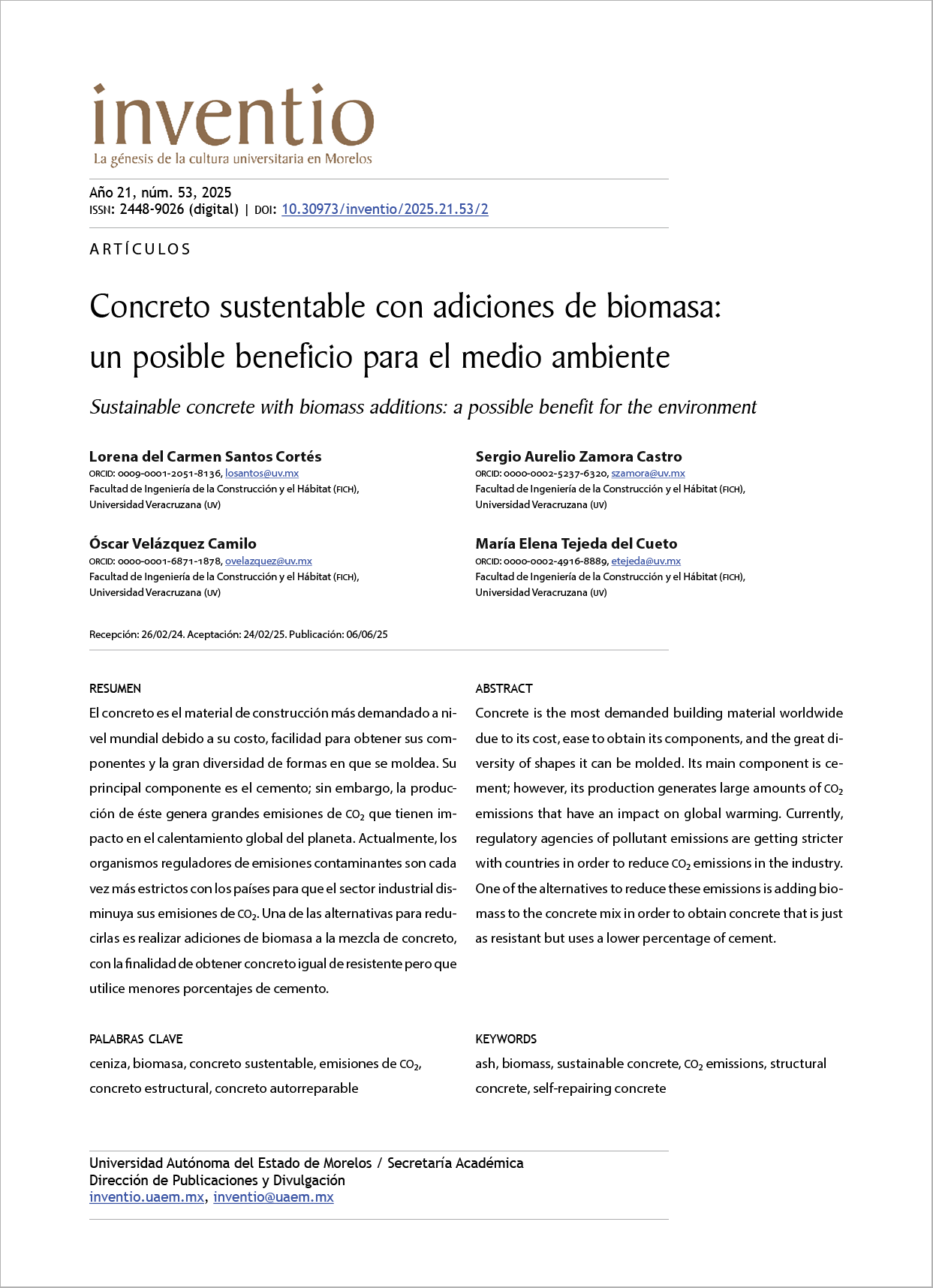
Sustainable concrete with biomass additions: a possible benefit for the environment
DOI:
https://doi.org/10.30973/inventio/2025.21.53/2Keywords:
ash, biomass, sustainable concrete, CO2 emissions, structural concrete, self-repairing concreteAbstract
Concrete is the most demanded building material worldwide due to its cost, ease to obtain its components, and the great diversity of shapes it can be molded. Its main component is cement; however, its production generates large amounts of co2 emissions that have an impact on global warming. Currently, regulatory agencies of pollutant emissions are getting stricter with countries in order to reduce co2 emissions in the industry. One of the alternatives to reduce these emissions is adding biomass to the concrete mix in order to obtain concrete that is just as resistant but uses a lower percentage of cement.
References
Al-Khalaf, M. N. y Yousif, H. A. (1984). Use of rice husk ash in concrete. International Journal of Cement Composites and Lightweight Concrete, 6(4), 241-248. https://doi.org/10.1016/0262-5075(84)90019-8
Andalib, R., Abd Majid, M. Z., Hussin, M. W., Ponraj, M., Keyvanfar, A., Mirza, J. y Lee, H.-S. (2016). Optimum concentration of Bacillus megaterium for strengthening structural concrete. Construction and Building Materials, 118, 180-193, https://doi.org/10.1016/j.conbuildmat.2016.04.142
Andrew, R. M. (2019). Global CO2 emissions from cement production, 1928-2018. Earth System Sciencie Data, 11(4), 1675-1710. https://doi.org/10.5194/essd-11-1675-2019
Brunauer, S. y Copeland, L. E. (1964). The chemestry of concrete. Scientific American, 210(4), 80-92. https://doi.org/10.1038/scientificamerican0464-80
Global Cement and Concrete Association (2021). Futuro del hormigón. Plan de trabajo hacia una industria del cemento y hormigón neutra en carbono para el 2050 de la Asociación Mundial de Productores de Cemento y Hormigón. GCCA. https://gccassociation.org/concretefuture/wp-content/uploads/2022/10/Roadmap_Spanish_2022.pdf
Goñi, S., Guerrero, A., Macías, A. y Lorenzo, M. P. (2011). “Materias primas alternativas para la fabricación de cementos más ecoeficientes de baja energía”. Revista de la Asociación Latinoamericana de Control de Calidad, Patología y Recuperación de la Construcción, 1(1), 17-29. https://www.redalyc.org/articulo.oa?id=427639584003
International Energy Agency (2018). Technology roadmap - Low-Carbon transition in the cement industry. IEA, sp. https://www.iea.org/reports/technology-roadmap-low-carbon-transition-in-the-cement-industry
Instituto Español del Cemento y sus Aplicaciones (2013). Guías Técnicas. Hormigón en ambiente marino. IECA. https://www.ieca.es/producto/hormigon-en-ambiente-marino/
Khedheyer Al-Alwan, A., Al-Bazoon, M., Mussa, F. I., Alalwan, H. A., Hatem Shadhar, M., Mohammed, M. M. y Fakhri, M. F. (2022). The impact of using rice husk ash as a replacement material in concrete: an experimental study. Journal of King Saud University - Engineering Sciences, 36(4), 249-255. https://doi.org/10.1016/j.jksues.2022.03.002
Lu, B., Shi, C. y Hou, G. (2018). Strength and microstructure of CO2 cured low-calcium Clinker. Construction and Building Materials, 188, 417-423. https://doi.org/10.1016/j.conbuildmat.2018.08.134
Matallana Rodríguez, R., (2019). El Concreto. Fundamentos y nuevas tecnologías. Constructora Concreto y Corona. https://fundacioncompartir.org/noticias/concreto-fundamentos-nuevas-tecnologias
Pixabay (8 de noviembre de 2006). Grano de arroz [fotografía]. Pixabay. https://www.pexels.com/es-es/foto/grano-de-arroz-164504/
Ponce de León, C.F., Huamani, S.K & Sánchez, E., (2015), “Los beneficios del uso de bacterias en el concreto autorregenerante”, No.7, pp.36-38, https://revistas.pucp.edu.pe/index.php/civilizate/article/view/16153/16575
Ribeiro, D. V. y Morelli, M. R. (2014). Effect of calcination temperature on the pozzolanic activity of brazilian sugar cane bagasse ash (SCBA). Materials Research, 17(4), 974-981. https://doi.org/10.1590/S1516-14392014005000093
Ruviaro, A. S, Santos Lima, G. T. dos, Silvestro, L., Taborda Barraza, M., Cavalcante Rocha, J., Brito, J. de, Gleize, P. J. P. y Pelisser, F. (2023). Characterization and investigation of the use of oat husk ash as supplementary cementitious material as partial replacement of Portland cement: analysis of fresh and hardened properties and environmental assessment. Construction and Building Materials, 363, 1-20. https://doi.org/10.1016/j.conbuildmat.2022.129762
Sakib, N., Hasan, R., Mutalib, A. A., Jamil, M, Raman, S. N. y Kaish, A. B. M. A. (2023). Utilization of sugar mill waste ash as pozzolanic material in structural mortar. Minerals, 13(3), 1-18. https://doi.org/10.3390/min13030324
Tan, K., Qin, Y. y Wang, J. (2022). Evaluation of the properties and carbon sequestration potential of biochar-modified pervious concrete. Construction and Building Materials, 314, Parte A, 1-12. https://doi.org/10.1016/j.conbuildmat.2021.125648
Thomas, B. S., Yang, J., Mo, K. H., Abdalla, J. A., Hawileh, R. A. y Ariyachandra, E. (2021). Biomass ashes from agricultural wastes as supplementary cementitious materials or aggregate replacement in cement/geopolymer concrete: a comprehensive review. Journal of Building Engineering, 40, 1-29. https://doi.org/10.1016/j.jobe.2021.102332
Zhipeng, L. y Xianming, S. (2023). Towards sustainable industrial application of carbon-negative concrete: synergistic carbon-capture by concrete washout water and biochar. Materials Letters, 342. https://doi.org/10.1016/j.matlet.2023.134368
Downloads
Published
Issue
Section
License
Copyright (c) 2025 Lorena del Carmen Santos Cortés, Óscar Velázquez Camilo, Sergio Aurelio Zamora Castro, María Elena Tejeda del Cueto

This work is licensed under a Creative Commons Attribution-NonCommercial 4.0 International License.
Esta revista proporciona acceso abierto inmediato a su contenido, con base en el principio de ofrecer al público un acceso libre a las investigaciones para contribuir a un mayor intercambio global de conocimientos. Se distribuye bajo una licencia Creative Commons Reconocimiento-NoComercial 4.0 Internacional License.